
How Does Ground Clearance Affect Highway Handling?
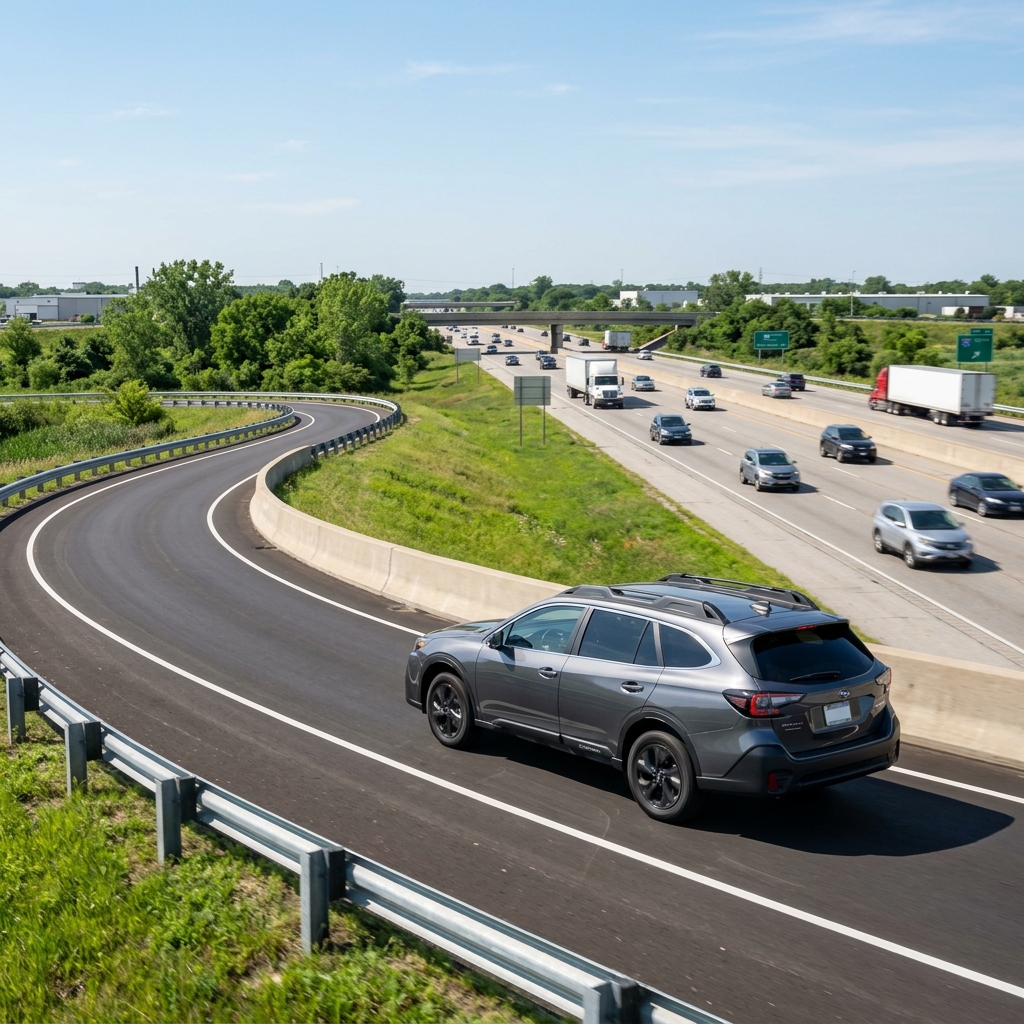
A dark gray SUV drives on a curved highway ramp next to a busy freeway on a sunny day. (Representative image for illustration purposes only. Actual vehicle may vary based on trim and configuration.)

For many drivers in the Plainfield and Joliet areas, the daily commute is a tale of two entirely different driving environments. The journey begins on the familiar, slow-moving neighborhood streets and stop-and-go commercial corridors of Route 59. Here, ride height is rarely a top-of-mind concern. You navigate minor speed bumps, pull into parking lots, and step over standard curbs with ease, barely giving a second thought to the physical distance between your vehicle's undercarriage and the pavement. At 25 to 35 miles per hour, the physical forces acting on your vehicle are relatively docile. The suspension moves gently over minor road imperfections, and the steering feels light and undemanding. It is a predictable, low-stress environment where almost any vehicle platform feels perfectly at home. However, the moment you steer onto the acceleration ramp of Interstate 55, the entire dynamic shifts. As your speedometer climbs from 30 to 70 miles per hour, your vehicle transitions from a slow-moving physical object into a high-speed aerodynamic body. Suddenly, the air around you is no longer a passive medium; it becomes a dense, invisible wall of resistance. The volume of air that your vehicle must slice through increases exponentially with speed, and with that increase comes a host of complex aerodynamic forces. At highway speeds, every millimeter of ride height—commonly referred to as ground clearance—plays an influential role in how your car, crossover, or SUV behaves. The distance between the road surface and your vehicle's underbelly determines not only how much wind resistance you encounter, but also how air flows underneath, around, and over your vehicle. This physical transition has a profound impact on driver confidence. When ground clearance is elevated, the volume of air trapped beneath the chassis increases, creating a natural lifting force that can subtly unweight the suspension. To the driver, this can manifest as a slight 'floaty' sensation, making the steering feel less centered and more disconnected from the road. Conversely, a lower-slung vehicle maintains a tight, restricted air boundary layer underneath, generating a localized low-pressure zone that naturally pulls the vehicle closer to the pavement. This 'planted' sensation is what gives drivers the confidence to maintain speed through sweeping highway curves and navigate high-speed merges without hesitation. Understanding how this delicate balance of ride height, aerodynamics, and gravity affects your highway drive is the first step in selecting a vehicle that perfectly aligns with your personal driving style and daily commuting needs. Furthermore, high-speed handling is not just about the numbers on a spec sheet; it is about how those numbers translate into real-world sensory feedback. When a vehicle is lower to the ground, its entire architecture is closer to its roll axis. This geometric alignment means that when you turn the steering wheel, the vehicle rotates with minimal body lean, allowing the tires to maintain an optimal contact patch with the road. Elevated vehicles, while offering unmatched versatility in deep snow or rough terrain, must combat these high-speed forces through sophisticated suspension engineering. In the sections that follow, we will break down the precise physics of underbody airflow, dissect the mechanics of weight transfer on highway ramps, and analyze how different ride heights impact your daily comfort and control.

How Is Ground Clearance Measured on a Passenger Car or SUV?

To fully appreciate how ride height influences your vehicle's road manners, it is essential to understand exactly how ground clearance is measured. Technically speaking, ground clearance—often referred to as ride height—is defined as the minimum distance between the flat, level ground surface and the lowest non-rotational point of the vehicle's chassis, underbody, or mechanical assemblies. This means that components like your tires and brake assemblies, which move directly with the wheel hubs, are excluded from this measurement. Instead, automotive engineers focus on structural components that remain fixed relative to the vehicle's body, such as the engine oil pan, the transmission housing, the exhaust system's catalytic converters, the fuel tank shield, and the lower control arm mounting brackets of the suspension. This measurement must be taken when the vehicle is at its curb weight—meaning it is fully loaded with all necessary fluids, fuel, and standard equipment, but carrying no passengers or cargo. It is a static measurement, but in the real world, ground clearance is highly dynamic. As you drive over dips, accelerate, or apply the brakes, the suspension compresses and rebounds, causing the actual distance between the chassis and the road to fluctuate constantly. If you are interested in how a pre-owned vehicle handles these dynamic shifts, you can Browse Used Inventory options at Hawk Subaru to compare various pre-measured heights and suspension configurations in person.

The baseline measurements vary dramatically across different automotive segments, each tailored to satisfy distinct driving priorities. Standard passenger sedans, such as the Subaru Legacy, are typically engineered with a ground clearance of approximately 5.5 to 5.9 inches. This low-slung stance is optimized for street efficiency, high-speed stability, and ease of passenger entry and exit. Moving up the scale, modern compact crossovers and midsize SUVs generally provide clearance measurements ranging from 6.7 to 7.8 inches, offering a middle ground that balances everyday utility with modest obstacle clearance. For drivers seeking authentic all-weather and off-road capability, rugged utility vehicles like the Subaru Forester, Outback, and Ascent establish a standard-setting baseline of 8.7 inches of ground clearance—extending to a formidable 9.5 inches on the adventure-ready Wilderness trims. By elevating the chassis to these heights, engineers allow the suspension system to utilize longer travel paths. While this long-travel setup excels at absorbing harsh vertical impacts from off-road obstacles and deep potholes, it fundamentally alters the vehicle's center of gravity and aerodynamic profile at highway velocities. Understanding these dimensional baselines allows shoppers to appreciate the structural compromises and engineering triumphs that define modern chassis design.

Why Do Low-Ground-Clearance Cars Usually Feel More Stable at High Speeds?
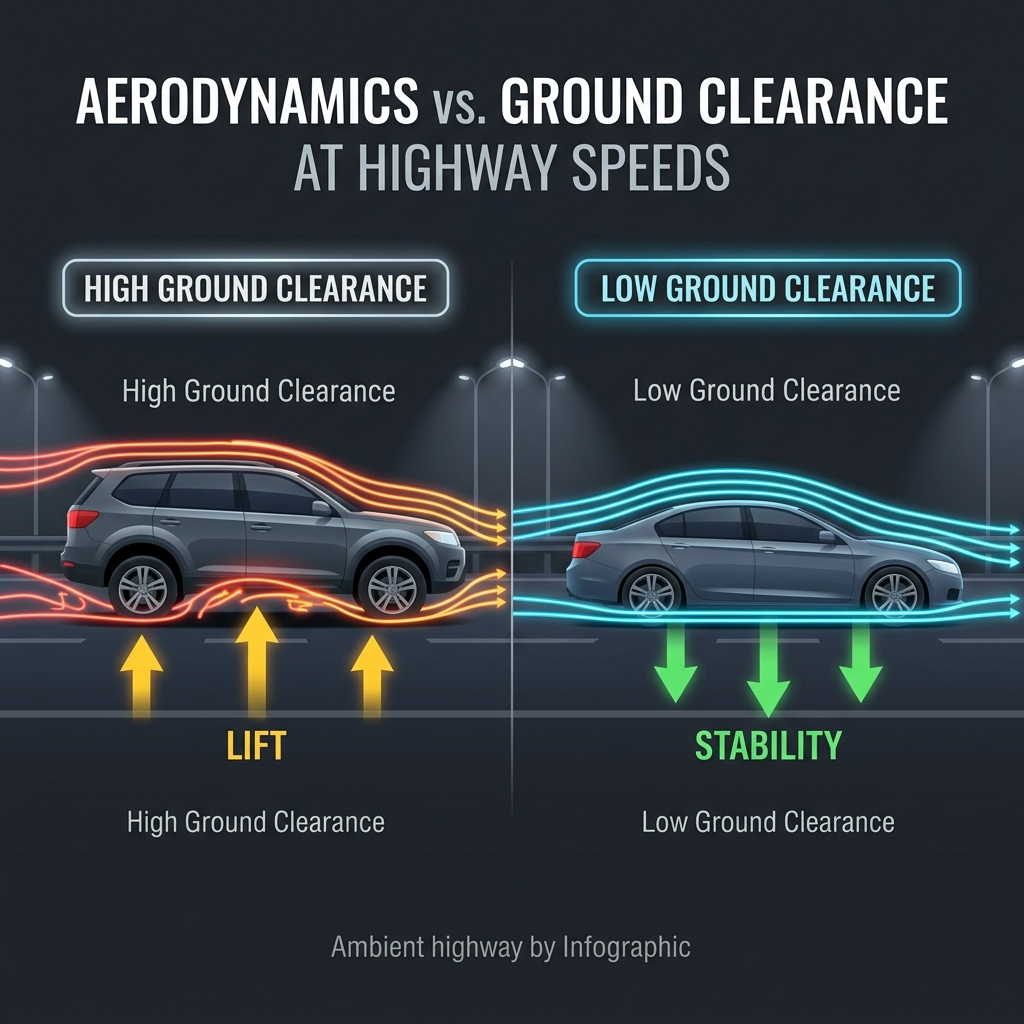
The relationship between a vehicle's ground clearance and its high-speed stability is anchored in the fundamental principles of automotive fluid dynamics. When a vehicle traveling at 70 miles per hour encounters oncoming air, it acts as a wedge, forcing the air mass to split into two primary streams: one flowing over the curved upper body of the car, and the other flowing underneath the flat chassis. In a low-ground-clearance vehicle, the physical gap between the undercarriage and the pavement is highly restricted. This narrow channel limits the volume of air that can pass beneath the car. Because the same mass of air must squeeze through a smaller physical space, the velocity of the underbody airflow increases dramatically relative to the air passing over the top. According to Bernoulli's principle of fluid dynamics, as the velocity of a fluid increases, its static pressure decreases. This creates a localized area of low pressure beneath the chassis.

{
"altText": "Infographic comparing how high ground clearance causes lift and low ground clearance creates stability.",
" (Representative image for illustration purposes only. Actual vehicle may vary based on trim and configuration.)

This low-pressure zone beneath the vehicle generates a powerful physical phenomenon known as 'downforce' or the 'ground effect.' In essence, the higher atmospheric pressure pushing down on the vehicle's roof and hood literally presses the car closer to the pavement, acting like an invisible magnetic force. This prevents the vehicle from experiencing aerodynamic lift—a dangerous condition where high-velocity air under the car unweights the suspension and reduces tire traction. By keeping the vehicle firmly planted, a low ride height ensures that the tire contact patches maintain maximum lateral grip against the asphalt. This translates directly into a highly predictable, confidence-inspiring driving experience. When you initiate a lane change or navigate a sweep on the highway, a low-clearance vehicle responds with immediate lateral acceleration and zero hesitation, maintaining its trajectory with surgical precision.

What Is Weight Transfer and How Does It Affect Cornering on Highway Ramps?

Every time your vehicle changes direction—whether you are carving through a sweeping highway exit ramp or executing an emergency evasive maneuver—it is subject to the inescapable laws of kinetic energy and weight transfer. When you turn the steering wheel, lateral acceleration forces (commonly referred to as G-forces) act upon the vehicle's mass, attempting to push it outward toward the edge of the curve. The vehicle's suspension system must manage this energy, absorbing the lateral load and transferring it through the springs, dampers, and anti-roll bars to the outside tires. The height of your vehicle's center of gravity plays a decisive role in how this weight transfer occurs. In a low-slung sedan, the center of gravity is positioned close to the road surface, minimizing the leverage that lateral forces can exert on the body. As a result, the vehicle experiences minimal body roll, keeping all four tire contact patches evenly loaded and maximizing cornering traction. Conversely, in a high-clearance crossover or SUV, the center of gravity is elevated significantly. This physical elevation creates a longer 'lever arm' between the vehicle's center of mass and its roll center (the imaginary point around which the body rolls). When entering a sharp highway ramp, this longer lever arm exerts substantially more torque on the suspension, causing the body of the vehicle to lean or roll outward more pronouncedly. This pronounced body roll shifts a massive portion of the vehicle's weight onto the outside tires while unloading the inside tires, which can lead to a sensation of side-to-side sway or instability. To compensate for this, high-clearance vehicles must utilize stiffer anti-roll bars or more complex suspension dampening to control body movement. If you are looking for a vehicle that minimizes this sway and delivers crisp, flat cornering dynamics, we invite you to Browse New Inventory at Hawk Subaru to experience our engineered chassis options firsthand.

How Does Highway Driving Feel Different in a High-Clearance SUV Versus a Low Sedan?
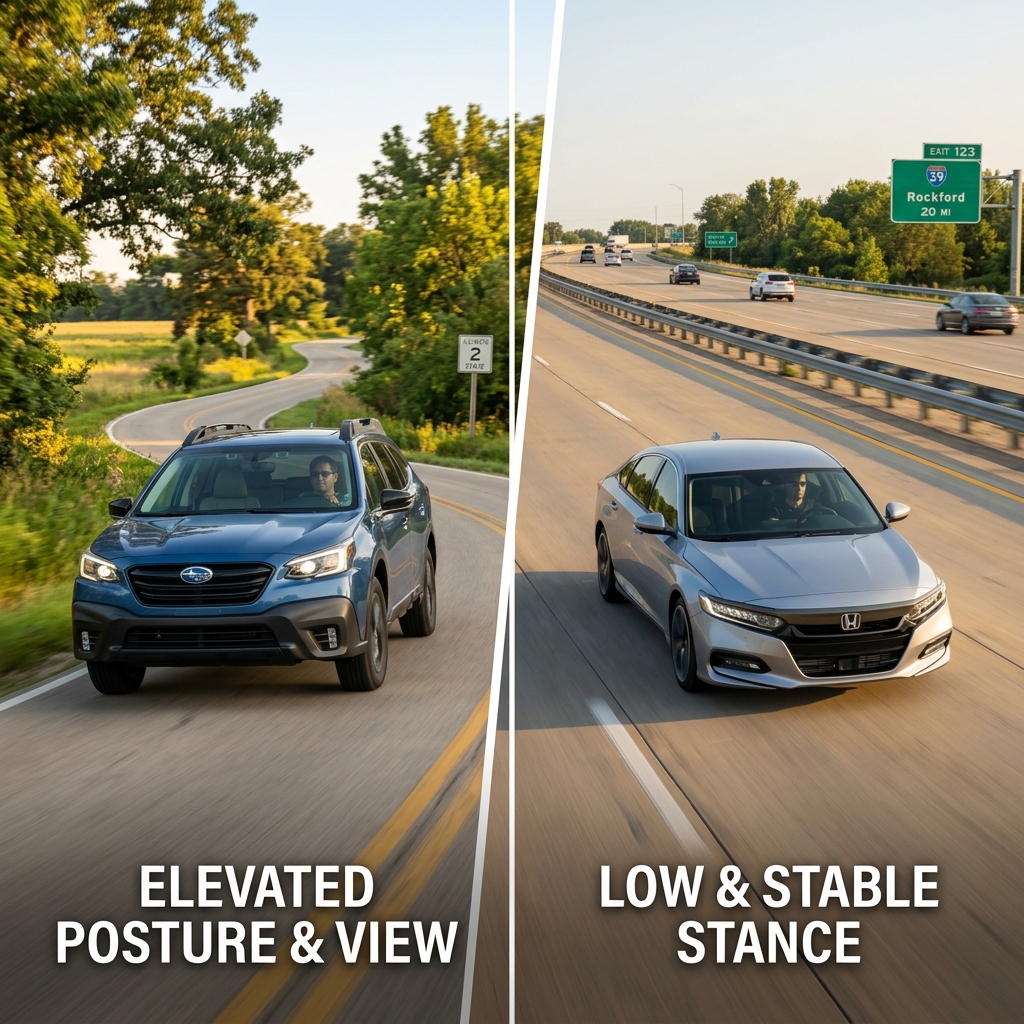
Split screen comparing a blue Subaru SUV on a winding road with a silver Honda sedan on a highway. (Representative image for illustration purposes only. Actual vehicle may vary based on trim and configuration.)

The real-world experience of driving a high-clearance SUV on the open road is vastly different from piloting a low-profile sedan, and each configuration offers unique advantages. In a high-riding crossover or SUV, the primary benefit is the sweeping, panoramic view of the surrounding environment. Sitting elevated above the general traffic flow allows you to spot potential hazards, sudden brake lights, or highway construction zones far in advance, giving you more time to react safely. Furthermore, the elevated ride height allows engineers to design long-travel suspension systems. These systems excel at swallowing up harsh highway expansion joints, concrete seams, and uneven lanes, delivering a plush, cloud-like ride quality that minimizes long-distance physical fatigue. In contrast, driving a low-slung sedan is a sensory-rich experience that emphasizes dynamic connection and mechanical intimacy. Because you sit closer to the asphalt, your inner ear and physical senses receive immediate, unfiltered feedback about the road surface and cornering forces. The steering feels remarkably direct and responsive; even minor steering inputs result in an instantaneous, flat change of direction. Additionally, the smaller frontal profile of a sedan slices through the air with far less resistance, resulting in a quieter, more serene cabin environment with minimal wind-induced whistling around the A-pillars. For drivers who prioritize the pure joy of driving, the immediate feedback and athletic responsiveness of a low sedan are tough to match.

Crosswinds and Semi-Truck Turbulence: Staying Centered in Your Lane

One of the most overlooked aspects of highway driving stability is how a vehicle responds to external aerodynamic forces, such as strong crosswinds and the violent air turbulence generated by large semi-trucks. When you are driving across the open, flat expanses of the Midwest, high winds can sweep across the roadway completely unobstructed. A vehicle's physical height directly correlates to its 'sail area'—the total lateral surface area exposed to these crosswinds. Taller vehicles, such as full-size SUVs and high-clearance crossovers, possess a significantly larger sail area than low-slung sedans. When hit by a sudden gust of wind, this large surface area acts like a physical sail, catching the wind force and translating it into a lateral push that can cause the vehicle to wander within its lane.

This phenomenon is amplified when passing or being passed by massive commercial semi-trucks traveling at high speeds. As a semi-truck punches through the air, it creates a massive high-pressure bow wave at its front bumper, followed by a low-pressure vacuum pocket along its trailer sides. When a high-clearance vehicle enters this turbulent zone, it experiences a rapid sequence of aerodynamic forces—first being shoved outward by the bow wave, and then violently sucked inward toward the trailer by the low-pressure wake. Because taller vehicles have an elevated center of mass, these fluctuating aerodynamic forces generate a noticeable yawing motion, causing the chassis to sway and requiring the driver to make continuous, active micro-steering corrections to remain centered.

Low-ground-clearance passenger cars, by comparison, navigate these turbulent environments with remarkable composure. Their compact lateral profiles present a much smaller target for crosswinds, and their lower center of gravity ensures that any lateral forces that do act upon the body have less leverage to upset the chassis. When passing a semi-truck, a low sedan slices cleanly through the pressure waves with minimal physical deviation, maintaining its straight-line tracking with very little input from the driver. This inherent stability significantly reduces driver fatigue on long-distance road trips, allowing you to arrive at your destination feeling relaxed and unstressed rather than physically worn out from wrestling with the steering wheel.

In Smooth Midwest Highways, Does Extra SUV Ground Clearance Justify Its Compromises?
A gray Mazda SUV driving on a long, straight highway through open countryside under a blue sky. (Representative image for illustration purposes only. Actual vehicle may vary based on trim and configuration.)

When discussing vehicle ride height and handling, geography plays an incredibly important role. Here in the Midwest, specifically in the communities of Plainfield, Joliet, and Naperville, our local highway network is characterized by vast, flat terrain and wide-open interstates. On paper, it might seem that a low-slung sedan is the ideal choice for these smooth, straight roadways. However, the realities of Midwest weather and infrastructure present a compelling counter-argument. Our region is subject to extreme seasonal transitions, starting with severe winter snowstorms that leave deep, rutted snowpacks, icy ridges, and high snowdrifts across local roadways. A low-clearance sedan can easily become high-centered in these conditions, with its underbelly scraping against hard snow and its drive wheels losing traction. Furthermore, the dramatic freeze-thaw cycles of the Midwestern spring wreak havoc on local asphalt, tearing open massive, tire-popping potholes along Route 59 and the surrounding interstates. A vehicle with generous ground clearance offers a critical safety margin in these scenarios, allowing the suspension to absorb the impact of a deep pothole without bottoming out or damaging expensive alloy wheels and suspension components. Additionally, local families frequently load up their vehicles for weekend recreational trips along the scenic DuPage River or local forest preserves. Navigating unpaved access roads, gravel parking lots, and grassy fields requires a level of underbody clearance that standard passenger cars simply cannot provide. For many local drivers, the peace of mind offered by an SUV's extra clearance during a sudden winter blizzard or spring flood easily outweighs the slight high-speed handling advantages of a low-slung sedan.

Subaru Symmetrical All-Wheel Drive: Overcoming the High-Clearance Handling Penalty

To overcome the traditional handling penalties associated with elevated ground clearance, Subaru engineers took a radically different approach to vehicle architecture. In a conventional high-clearance SUV, a heavy inline-four or V6 engine stands vertically in the engine bay. This places a massive amount of weight high up in the chassis, raising the overall center of gravity and exacerbating body roll and high-speed instability. Subaru bypassed this limitation entirely by designing the horizontally opposed Subaru BOXER® engine. In this unique configuration, the pistons move horizontally rather than vertically, allowing the entire engine block to be remarkably compact and sit incredibly low in the engine compartment. This ultra-low engine placement lowers the vehicle's center of gravity to a level that rivals many standard passenger cars, even when the vehicle boasts an impressive 8.7 inches of ground clearance.

This low center of gravity is paired with Subaru's legendary Symmetrical All-Wheel Drive system. Unlike slip-and-grip systems that only send power to the wheels after traction is lost, Symmetrical AWD maintains a continuous, balanced flow of power to all four wheels. This constant power distribution provides active lateral stability, helping to pull the vehicle through corners and counteract the natural body roll of an elevated ride height. The result is a vehicle that offers the adventurous capability and high visibility of an SUV, but handles with the planted, agile confidence of a sporty sedan. To keep these sophisticated mechanical systems operating at peak efficiency, it is essential to perform routine maintenance. You can easily Schedule Your Service Today at our specialized center, or consult our Parts Center for genuine OEM components to preserve your Subaru's legendary driving dynamics.

How Can Shoppers Evaluate Whether a Vehicle’s Ground Clearance Feels Right During a Test Drive?

When shopping for a new vehicle, the test drive is your single best opportunity to evaluate how a vehicle's ground clearance matches your personal driving style. To truly understand its high-speed handling characteristics, you must look beyond the standard low-speed dealership loop and take the vehicle onto the highway. The first item on your evaluation checklist should be the high-speed highway merge. As you accelerate down the entrance ramp, pay close attention to the vehicle's straight-line tracking. Does the steering feel tight, centered, and responsive as you reach 70 mph, or does it require constant, minor adjustments to stay in the center of the lane? A well-engineered chassis should feel naturally stable and directional.

Next, evaluate the vehicle's behavior on a sweeping highway curve or cloverleaf exit ramp. As you enter the curve, focus on the sensation of body roll. Note how much the body leans outward and how quickly the suspension settles when you transition back to a straight line. If the vehicle experiences excessive side-to-side sway or takes several seconds to stop bouncing after a bump, its suspension may be too soft for your handling preferences. Also, listen carefully to the cabin acoustics. A taller vehicle naturally creates more aerodynamic turbulence, which can manifest as wind noise around the side mirrors and windshield. A quiet, serene cabin at highway speeds is a hallmark of excellent aerodynamic engineering.

Finally, pay close attention to the steering feedback and overall ride comfort over uneven highway pavement. If you drive over expansion joints, bridge transitions, or minor road ripples, does the vehicle maintain its course confidently, or does it feel skittish and unsettled? A vehicle with proper ground clearance and suspension tuning should absorb these vertical impacts smoothly without transferring harsh vibrations into the steering wheel or cabin floor. By systematically evaluating these five areas during your test drive, you can make an informed, confident decision about whether a vehicle's ride height and chassis dynamics align with your daily commuting expectations.

Comparing Popular Models: Clearance Specs Across the Subaru Lineup

To help you visualize how ground clearance is tailored across the Subaru lineup, we have compiled a detailed comparison of our most popular models. From sporty, low-slung commuter cars to rugged, adventure-ready wilderness conquerors, each Subaru vehicle is engineered to deliver a specific balance of highway refinement, fuel efficiency, and off-road capability. By comparing these specifications, you can easily identify which model offers the perfect geometry for your lifestyle.

Model

Ground Clearance (Inches)

Primary Driving Character

Subaru Impreza

5.1

Sporty, low-slung agility and immediate steering response for daily pavement driving.

Subaru Legacy

5.9

Smooth, quiet, and highly stable highway cruising with minimized body roll.

Subaru Crosstrek

8.7

Aggressive urban versatility, easily clearing obstacles while maintaining crossover nimbleness.

Subaru Forester

8.7

High-riding visibility, generous cargo access, and superb all-weather capability.

Subaru Outback

8.7

The ultimate balance of car-like highway comfort and rugged off-road clearance.

Subaru Ascent

8.7

Family-sized road trip companion with robust utility and confident inclement-weather posture.

Subaru Outback Wilderness

9.5

Maximum trail clearance and underbody protection, built for heavy off-road excursions.

Maintaining Your Suspension: How Alignment and Shocks Protect Highway Stability
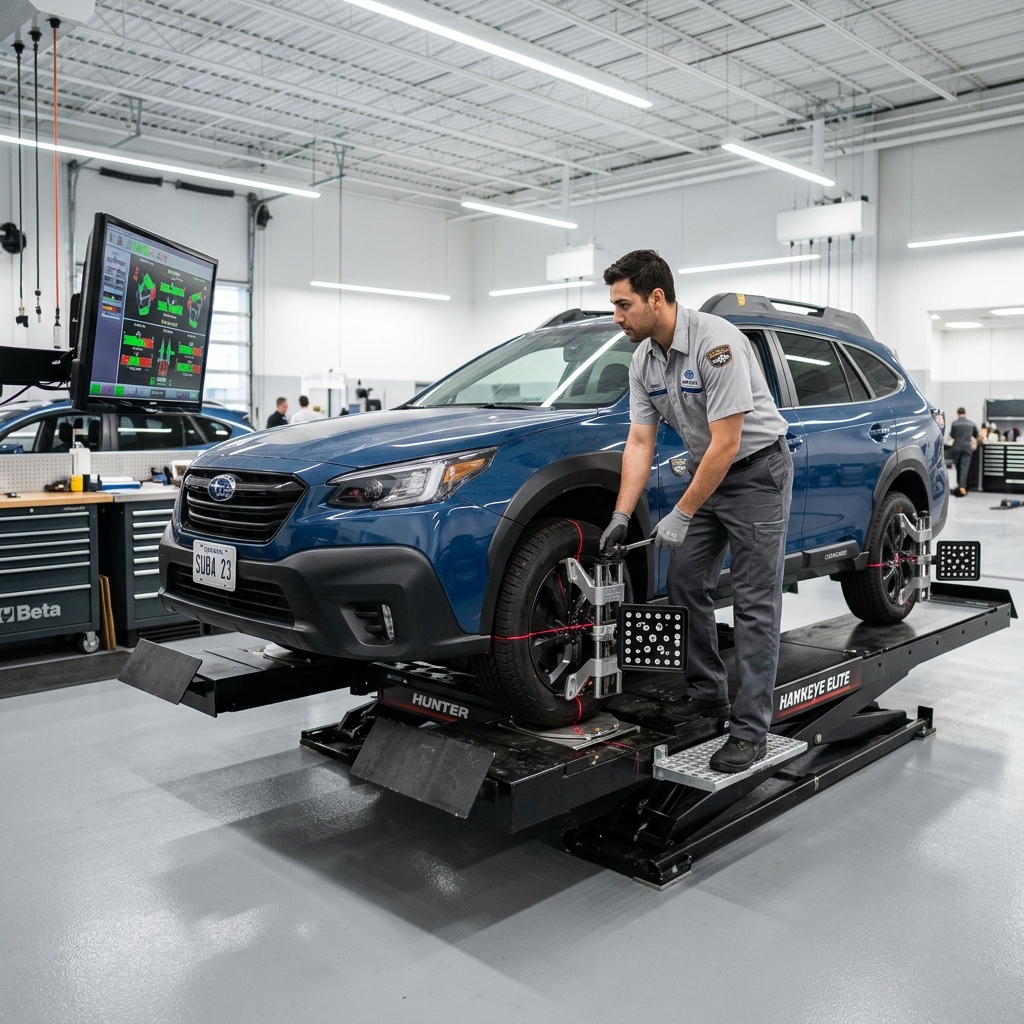
Even the most advanced, perfectly engineered suspension system will gradually degrade over time, and this degradation is particularly noticeable in high-clearance vehicles. Because taller crossovers and SUVs naturally experience greater suspension travel and carry a higher center of mass, their springs, shock absorbers, bushings, and anti-roll bars are subjected to intense physical forces during daily highway driving. Over tens of thousands of miles, shock absorbers lose their internal hydraulic dampening force, which can cause the vehicle to bounce excessively, lean heavily in corners, and feel floaty at high speeds. Misaligned wheels can also compromise your highway tracking, forcing you to fight the steering wheel just to stay straight. To prevent these safety hazards and preserve your vehicle's original handling dynamics, regular suspension maintenance is essential. We recommend having your wheel alignment checked at least once a year, rotating your tires every 6,000 miles to ensure even wear, and having a certified technician inspect your shock absorbers and bushings for signs of wear or leaking fluid. To make sure your suspension is performing at its absolute best, you can Schedule Your Service Today at Hawk Subaru. Our factory-trained technicians utilize state-of-the-art diagnostic equipment to keep your vehicle running safely and smoothly.

A mechanic in a gray uniform adjusts a wheel alignment sensor on a blue Subaru SUV mounted on a lift. (Representative image for illustration purposes only. Actual vehicle may vary based on trim and configuration.)

Find Your Perfect Balance of Ground Clearance and Agile Handling at Hawk Subaru

At Hawk Subaru, we understand that finding the perfect balance between elevated ground clearance and agile highway handling is a deeply personal choice. Whether you prefer the low-slung, athletic responsiveness of a passenger sedan or the commanding visibility and rugged capability of a high-clearance SUV, our extensive inventory has a vehicle designed to exceed your expectations. We invite drivers from Plainfield, Joliet, and Naperville to visit our state-of-the-art showroom located at 2401 Rte, 59, Plainfield, IL 60586. You can easily Get Directions to Hawk Subaru to plan your visit, or Call us at (815) 725-3789 to speak directly with our friendly, knowledgeable staff. Our team of dedicated professionals is here to guide you through every step of your automotive journey, from the initial test drive to long-term maintenance. To streamline your buying process, you can Get Pre-Approved for Financing online before visiting the dealership, and Value Your Trade-In to discover the current market value of your existing vehicle. Stop by Hawk Subaru today and discover why we are the trusted automotive resource for the entire Plainfield community.