Is It Safe to Drive at Highway Speeds on a Plugged Tire? The Bottom-Line Answer
If you are looking for a quick, unequivocal answer to whether you can merge onto Interstate 55 or Interstate 80 at 65 to 70 mph on a tire that was recently repaired with a standalone exterior string plug, the direct engineering answer is: No, it is not safe. A standalone tire plug inserted from the outside of the tread without removing the tire from the wheel is strictly a temporary roadside emergency measure. It is designed solely to keep enough air in your tire to allow you to limp off the highway shoulder and travel at low speeds directly to a qualified repair facility.
According to mandatory safety standards established by the U.S. Tire Manufacturers Association (USTMA) and the Tire Industry Association (TIA), a permanent and highway-safe tire repair requires a two-piece stem-and-patch combination (or a single combination patch/plug unit) installed from the inside of the tire cavity. This process demands that the tire be fully demounted from the rim so an expert technician can perform a thorough internal inspection for hidden structural damages. Without an internal visual check and a vulcanized chemical bond sealing the inner liner, high-speed centrifugal forces, frictional heat, and continuous sidewall flexing can cause an exterior plug to fail suddenly, leading to explosive air loss or catastrophic tread separation.
What Is the Difference Between a Tire Plug and a Tire Patch?
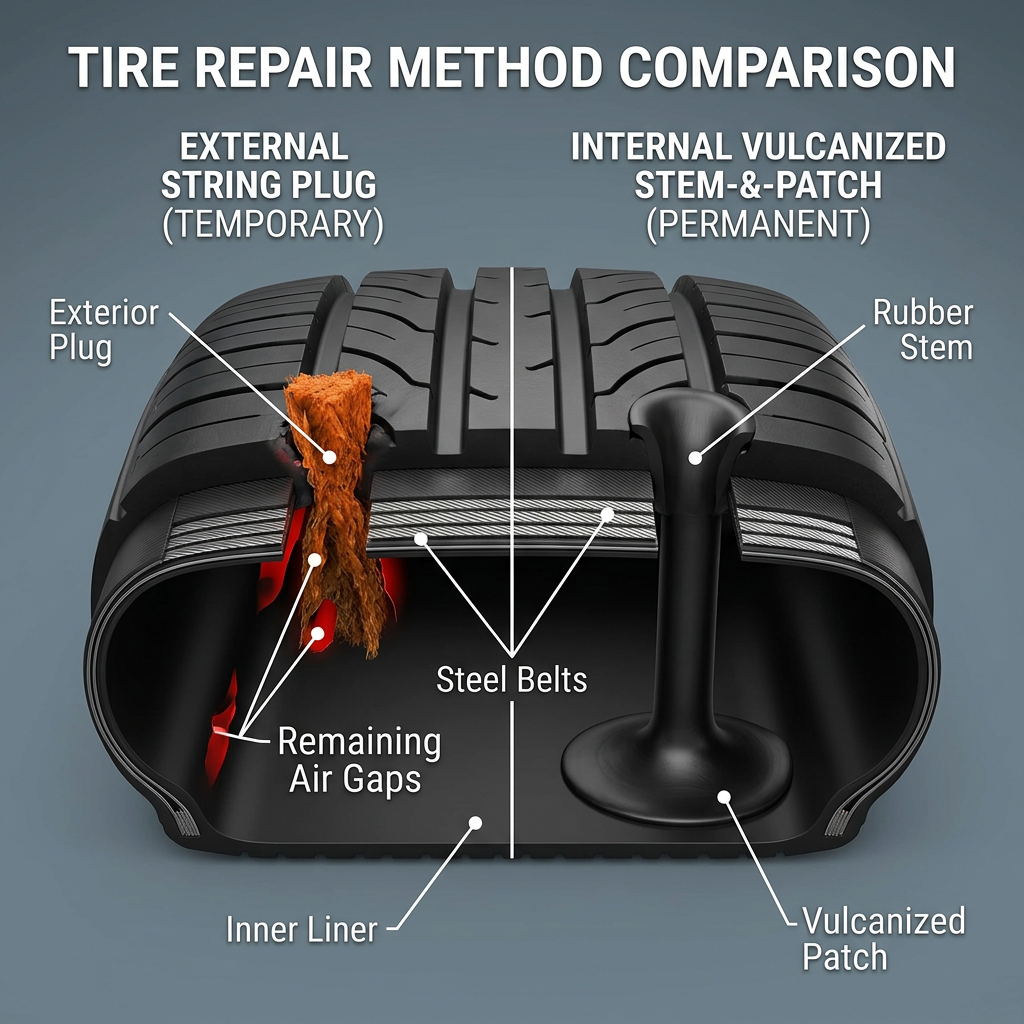
The Mechanical Anatomy of a Plug: An external tire plug is a pliable strip of fabric saturated with unvulcanized sticky rubber. To install it, a T-handle reaming tool is pushed into the puncture hole to clear foreign debris and force open the steel belts. The sticky plug strip is then jammed into the hole from the outside using an insertion needle and trimmed flush with the outer tread blocks. While this fills the physical gap to temporarily trap air inside, it does not seal the inner liner of the tire, nor does it bond permanently with the rubber casing.
The Science of an Internal Patch-Plug Combination: A true permanent repair involves demounting the tire from the wheel. The interior surface surrounding the puncture is mechanically buffed to expose raw, clean rubber, and a specialized rubber solvent/cement is applied. A vulcanized rubber patch with an attached stem is pulled through the puncture hole from the inside out. The stem fills the injury channel to prevent water and road salt from rusting the internal steel belts, while the chemical patch chemically welds itself to the airtight inner liner under controlled chemical reaction. This dual-action repair restores structural integrity.
Plug vs Patch: Which Is Right for Your Tire?
When an Emergency Plug Is Acceptable: Pushing a temporary rubber plug into a flat tire is a life-saving skill when stranded on a rural shoulder or during an emergency along Route 59. It enables you to reinflate the tire and drive slowly (under 45 mph) to a safe location or nearest service bay. However, treating a quick external plug as a permanent resolution is a hazardous mistake. Everyday commuting demands an airtight, certified bond capable of withstanding extreme thermal shifts and rapid braking deceleration.
When a Full Combination Patch Is Mandatory: Whenever you plan to operate your vehicle at normal highway speeds, carry passengers, or navigate severe winter weather across Northern Illinois, a combination USTMA patch-and-plug is mandatory. Running on a string plug at 65+ mph subjects the unvulcanized material to intense heat buildup. Moisture can travel down the puncture shaft, corroding internal steel belts and creating hidden air pockets that can detach the tread unexpectedly.
Where on a Tire Can a Puncture Be Safely Repaired?
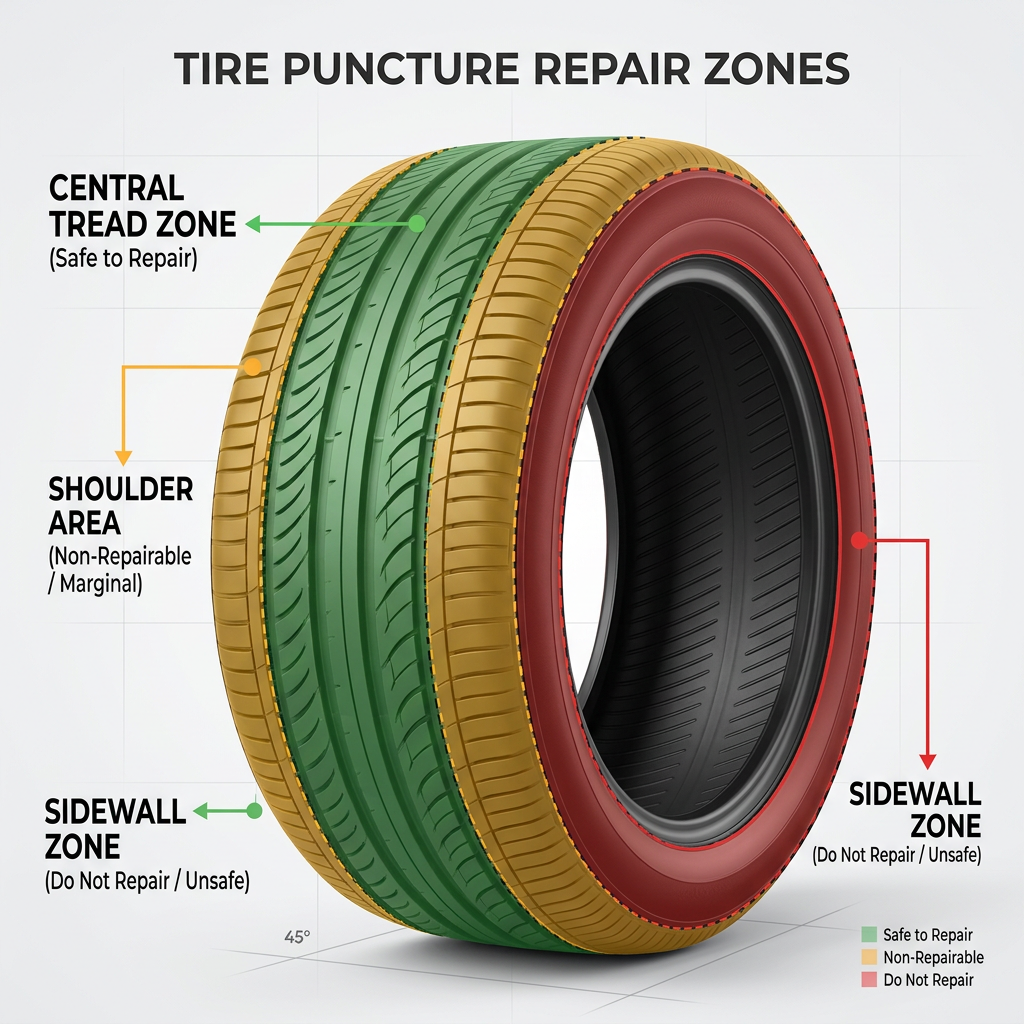
Central Tread Zone (Safe)
Punctures located strictly within the central crown area—defined as the tread surface situated at least 1.5 inches inward from both outer shoulders—can be safely repaired using standard internal patch-and-plug procedures, provided the hole diameter is 1/4 inch (6mm) or smaller.
Shoulder Area (Unsafe)
The shoulder block region undergoes intense lateral flex, curvature changes, and heavy load concentration during turns. Plugs or patches applied to the shoulder will rapidly work themselves loose due to continuous mechanical stress, creating severe blowouts.
Sidewall Zone (Strictly Prohibited)
Sidewalls carry the vertical weight of the vehicle and flex thousands of times per mile. There are no steel belts inside sidewalls to hold structural shape under repair pressure. Any puncture, scuff, or cut in the sidewall permanently compromises structural stability and requires tire replacement.
The Engineering Risks of High-Speed Driving on an Emergency Tire Plug
When a light passenger vehicle travels down the highway at 70 mph, each tire rotates approximately 800 to 1,000 revolutions per minute. At these high velocities, immense dynamic forces act upon the tire structure simultaneously:
• Centrifugal Force & Plug Ejection: High rotational acceleration creates intense outward forces. An external plug lacks a physical interior anchor backing, meaning centrifugal pull can force the pliable string plug outward, resulting in rapid loss of inflation. • Internal Heat Accumulation: High speeds generate friction-induced thermal expansion. Unvulcanized plug adhesive degrades quickly when internal tire temperatures exceed 160°F–180°F, softening the bond and enabling air pressure to force its way out. • Corrosion of Steel Belts: Because an external plug does not seal the inner liner from inside the tire cavity, moisture and ambient humidity continuously seep through the puncture stem. Over time, water rusts internal steel cords, weakening the casing framework. • Voiding Manufacturer Speed Ratings: Installing an external string plug immediately voids the manufacturer's official speed rating (e.g., H, V, Z ratings). A plugged tire can no longer guarantee structural performance at elevated speeds.
What Tools Are Included in a Standard Tire Plug Kit?
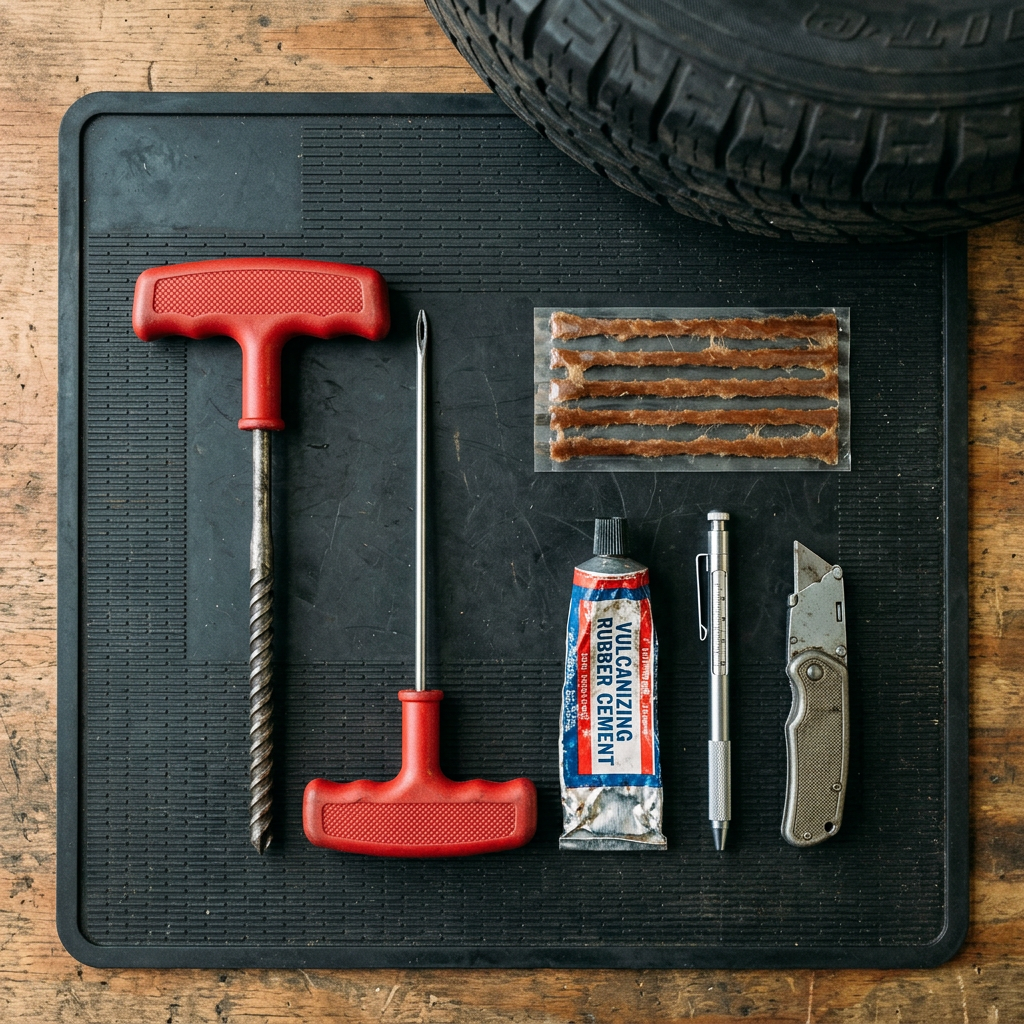
Kit Components
• Heavy-duty T-handle rasp/reamer tool • T-handle split-eye insertion needle • Sticky butyl rubber plug strips • Rubber cement or liquid vulcanizer • Folding utility knife & tire pressure gauge
Usage Steps
1. Remove offending nail/screw with pliers. 2. Insert reamer to clean and roughen entry hole. 3. Thread plug strip into split-eye needle. 4. Apply cement and push strip 2/3 into puncture. 5. Pull needle straight out and trim excess strip.
Safety Precautions
• Never ream a puncture hole wider than 1/4 inch. • Do not attempt roadside plugs on sidewalls. • Reinflate tire immediately and monitor pressure. • Limit speed to under 45 mph after repair.
How Much Does It Cost to Plug Versus Patch a Tire?
DIY Plug Kits ($10 – $20): Emergency store-bought plug kits cost very little upfront. However, relying on an external plug as a long-term solution frequently leads to slow leaks that ruin tire pressure monitoring sensors (TPMS), cause uneven tread wear, or cause complete tread belt separation—costing hundreds of dollars in damage.
Professional Combination Patch Repairs ($25 – $50): Having a certified service technician demount the tire, perform an internal inspection, apply a vulcanized patch-plug, rebalance the wheel, and reinstall it costs between $25 and $50. Investing in a true USTMA-compliant repair protects your tire investment and safeguards your vehicle stability.
|
Repair Factor
|
Emergency String Plug
|
Professional Patch/Plug Combination
|
|
Average Cost
|
$10 - $20 (DIY Kit)
|
$25 - $50 (Certified Facility)
|
|
Tire Demounted?
|
No (External only)
|
Yes (Full internal inspection)
|
|
Highway Speed Safe?
|
No (Temporary under 45 mph)
|
Yes (Restores full structural rating)
|
|
USTMA Compliant?
|
No
|
Yes
|
Do Tire Service Shops Offer Free Flat Tire Repairs in Naperville and Joliet?
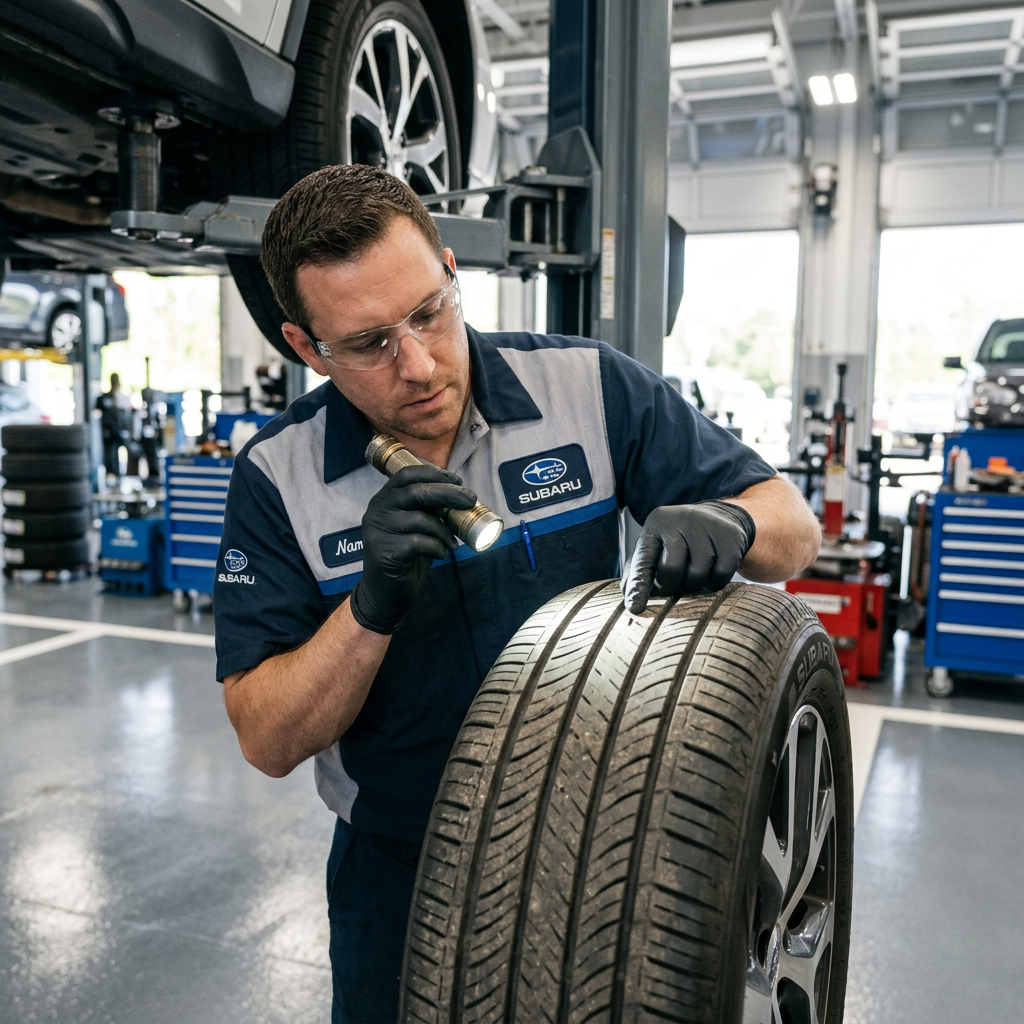
Drivers around Plainfield, Joliet, and Naperville frequently ask whether local dealership service bays provide complimentary tire health checks or flat repairs. Many original equipment manufacturer (OEM) tire packages and certified dealership programs include complimentary road hazard protection, free tire pressure inspections, and complimentary flat tire assessments. If you bought your tires or vehicle from a certified dealer, your repair or replacement might be covered under active warranty protection. Even if your tire was purchased elsewhere, certified dealership technicians will perform a comprehensive multi-point inspection to determine whether your tire can be safely repaired to USTMA standard specs or if replacement is required.
Why Subaru Symmetrical All-Wheel Drive Requires Special Care with Repaired Tires
Strict Tread Depth Tolerances (2/32 Inch Rule): Subaru Symmetrical All-Wheel Drive is an engineering masterpiece, delivering continuous torque to all four wheels. However, to prevent premature stress on center differentials and transfer cases, Subaru engineering mandates that all four tires must maintain matching overall rolling circumferences. The variance in tread depth between all four tires must strictly be within 2/32 of an inch.
Preventing Drivetrain Strain: If a temporary plug causes chronic slow air leaks, or if an unrepairable punctured tire is replaced with a brand-new full-tread tire while the remaining three tires are significantly worn, the circumference mismatch causes differential gears to bind continuously at highway speeds. This generates excess heat and can cost thousands in drivetrain repairs. Proper tire evaluation by a certified technician is essential for every Subaru driver.
Step-by-Step Action Plan: What to Do When You Get a Flat on Plainfield Roads
Step 1: Pull Off Safely
As soon as your TPMS warning light illuminates or you feel vibration, turn on hazard lights and carefully pull off traffic onto a level, paved shoulder or parking lot. Do not drive on a fully deflated tire, as rim contact destroys the tire sidewall within yards.
Step 2: Install Spare or Plug
Mount your compact spare tire or insert an emergency roadside plug if you carry a kit. Reinflate to manufacturer-recommended PSI listed on the driver door jamb placard. Keep speeds strictly under 45 mph.
Step 3: Head to Service Center
When Is a Punctured Tire Unrepairable and Needs Replacement?
Mandatory Retirement Criteria: Not all flat tires can be safely repaired. A tire MUST be replaced if it exhibits any of the following conditions: • Puncture diameter exceeds 1/4 inch (6mm) • Puncture occurs on shoulder blocks or sidewall • Tire was driven on while completely deflated (damaging internal rubber liners into black dust) • Tread depth is at or below 2/32 of an inch
Overlapping & Multiple Punctures: If a tire has suffered prior repairs and a new puncture occurs within 16 inches of an existing patch, industry USTMA guidelines prohibit making a second repair. In addition, tires showing severe dry rot, age cracking, bulging, or exposed internal steel belts must be replaced immediately to ensure driver safety on public roads.
Schedule Professional Tire Repair and Inspection at Hawk Subaru in Plainfield
Do not leave your highway safety to chance with a temporary roadside plug. The factory-trained master technicians at Hawk Subaru in Plainfield, IL are ready to perform comprehensive USTMA-certified tire inspections, chemical patch-plug repairs, wheel balancing, and AWD tread depth evaluations. If you need new tires, explore our complete inventory of major brand replacement tires backed by national manufacturer warranties. You can Schedule Your Service Today online or contact our service advisors directly.