What Services Are Typically Included in a Winterization Maintenance Package?
Operating a motor vehicle through a northern Illinois winter is an unforgiving endurance trial for mechanical systems, electrical networks, and chemical fluids. Between prolonged polar vortex freezes, biting sub-zero wind chills rolling off Lake Michigan, and heavy liquid brine applications across Interstate 55 and Route 59, standard three-season vehicle operation quickly reveals underlying mechanical weaknesses. A professional winterization maintenance package is an exhaustive, preventative engineering inspection and service designed to harden every critical subsystem of your vehicle against freezing temperatures, caustic road treatments, and reduced traction environments before harsh winter storms strike Plainfield, Naperville, and Joliet.
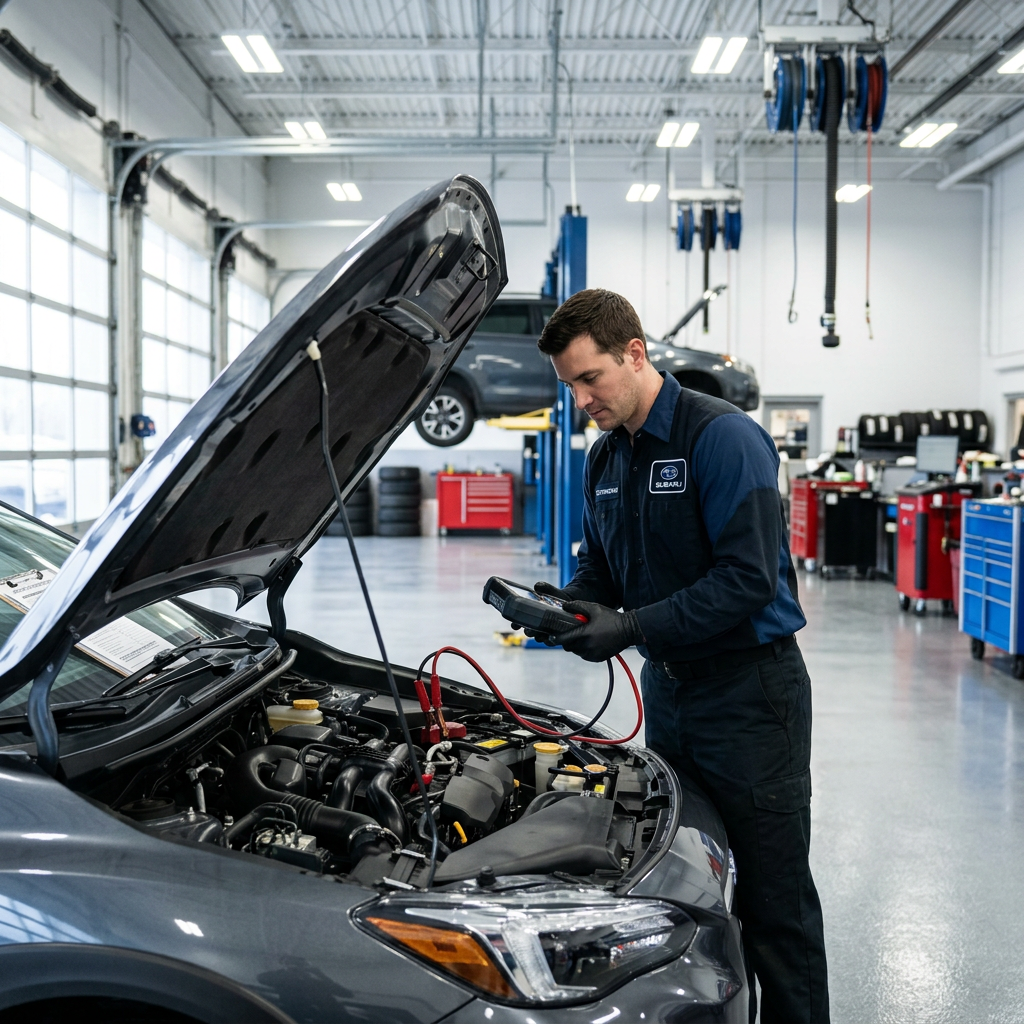
At its core, a complete automotive winterization package transcends a routine oil change and windshield wipe-down. Certified factory winterization programs address seven interrelated systems: electrical storage and cold-cranking capacity, engine thermal regulation and antifreeze freeze-point calibration, winter-weight lubricant transitions, hydraulic brake fluid moisture analysis and mechanical caliper assessment, HVAC defroster and cabin air airflow validation, freeze-proof washer solvent and wiping blade upgrades, and comprehensive tire contact-patch evaluation including tread geometry and cold inflation pressures. Neglecting any one of these pillars leaves commuters vulnerable to dangerous highway stalls, clouded visibility, and catastrophic component failure during severe Midwestern weather events.
Battery Load Testing and Cold-Cranking Diagnostic Checks
The fundamental electrochemical process inside a lead-acid or AGM 12-volt battery relies entirely on chemical kinetics that decelerate drastically as thermal energy plummets. When the ambient temperature falls to 32°F, a conventional automotive battery forfeits approximately 20 to 35 percent of its maximum rated electrical output. When polar winds drive ambient readings down to 0°F or below—commonplace along the open fields surrounding Plainfield—available starting power plunges by 50 percent or more. Simultaneously, engine oil congeals into a thick, viscous fluid, requiring the starter motor to pull between two and three times more amperage to turn the crankshaft over at adequate starting velocity.
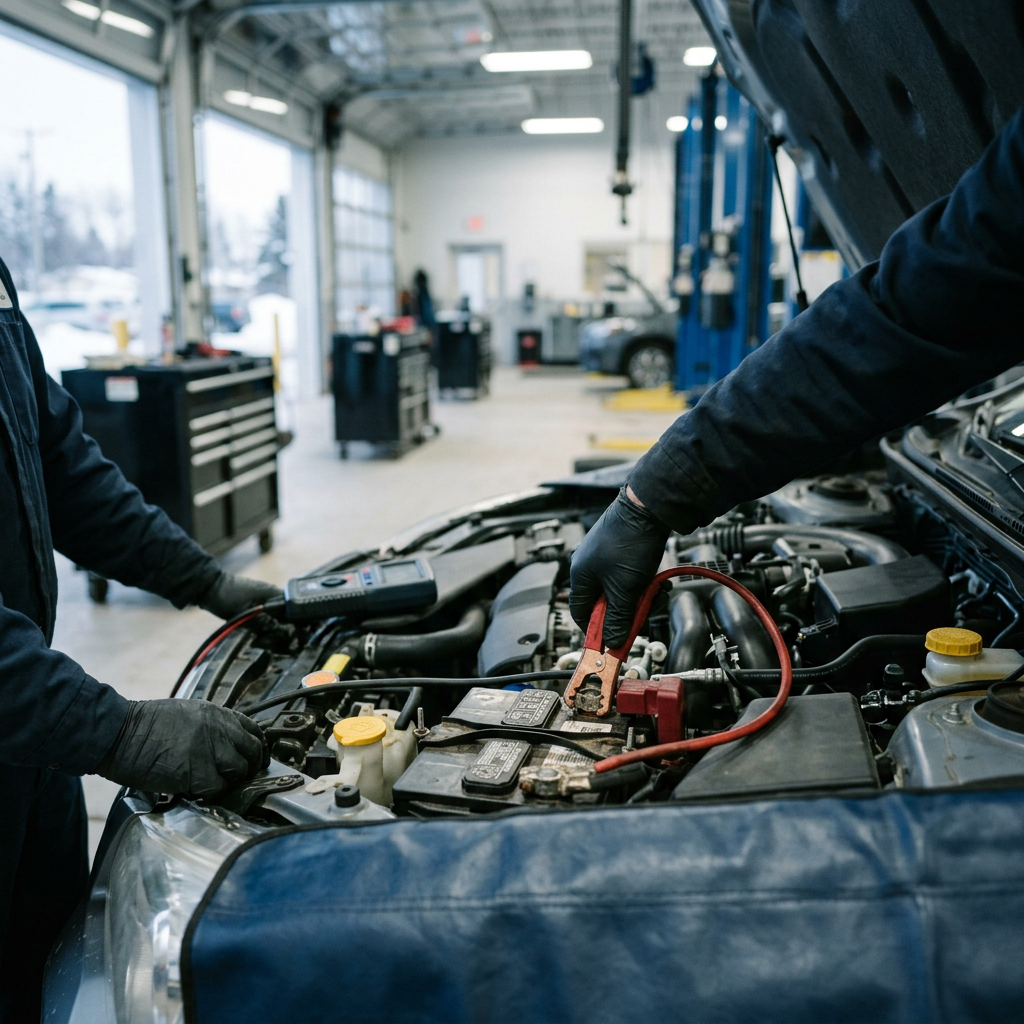
A comprehensive winterization package moves beyond basic open-circuit voltage tests by applying professional digital conductance profiling and carbon-pile simulated load testing. Digital conductance instruments transmit an alternating current frequency through the battery plates to assess internal cell resistance, plate sulfation, and structural degradation without draining the battery reserve. If a battery labeled for 650 Cold Cranking Amps (CCA) only delivers 380 CCA under conductance diagnostic evaluation, it will reliably strand a motorist outside an office or store on a bitter December evening.
Equally critical is the mechanical cleaning and chemical neutralizing of lead terminal posts. Airborne moisture combined with battery sulfuric acid vapor creates blue-green copper sulfate and lead sulfate blooming, introducing parasitic resistance that chokes starter current flow. Technicians scrub posts down to bare metal, torque down terminal clamping bolts to factory specification, seal terminals with anti-corrosion dielectric petroleum barriers, and test alternator charging ripple voltage under full blower-motor, seat-heater, and defroster loads.
How Can Drivers Test Battery Health at Home Before Holiday Highway Trips?
Before setting off on long family road trips across Interstate 55 or Interstate 80, motorists can execute reliable preliminary electrical diagnostics in their driveway using a handheld digital multimeter. To achieve an accurate reading, allow the vehicle to rest with the ignition turned off for at least four to six hours to dissipate any alternator surface charge across the battery plates. Switch your multimeter selector dial to 20V Direct Current (DC). Secure the red positive probe against the positive battery terminal post and the black negative probe against the negative terminal post.
Interpret your static voltage readings according to the standard state-of-charge reference scale: • 12.66V to 12.80V: 100% Fully Charged (optimal internal state) • 12.45V: Approximately 75% Charged (adequate, but reserve margin is declining) • 12.20V: 50% Charged (substantially compromised; battery requires immediate external charging) • 11.90V or lower: Fully Discharged (severe risk of internal plate sulfation and freeze-cracking) Next, perform a live cranking voltage check with a partner. Monitor the multimeter display while cranking the engine. If the voltage plunges below 9.6 volts during ignition turnover at 60°F or below 8.5 volts in sub-freezing air, the battery has surrendered its internal load-carrying integrity.
Physical visual inspection is just as informative as voltage measurements. Inspect the battery housing under bright illumination for signs of thermal stress and casing deformation. A battery case that displays bulging, warped lateral walls indicates excessive internal heat generated by severe overcharging, warped internal lead plates, or the expansion of freezing electrolyte fluid following a deep discharge. If you smell a persistent rotten egg or sulfur odor, sulfuric acid has overheated, venting volatile hydrogen sulfide gases through the pressure relief caps.
Inspect the manufacture date code stamp molded into the plastic top cover or printed on the side decal. Most automotive lead-acid batteries maintain a realistic operating lifespan of 36 to 48 months in harsh northern Illinois seasonal extremes. If your multimeter reveals sub-12.4V resting figures, significant cranking drops, or your battery is past its third operational year, you should schedule service online with certified technicians for comprehensive conductance diagnostics and OEM-grade replacement before high-speed holiday travels.
Coolant Hydrometer Testing, Freeze-Point Calibration, and Hose Inspections
50/50 Calibration & Refractometry
Engine coolant (antifreeze) serves a dual imperative: transferring combustion heat away from cylinder walls while lowering the solution freezing point. Pure ethylene glycol freezes at roughly 9°F, and pure water freezes at 32°F. However, when blended in a precise 50/50 volumetric ratio, their eutectic interaction depresses the freezing threshold down to -34°F. Using an optical refractometer, technicians verify true refraction indices to safeguard against slush formation that destroys water pumps.
Thermostat & Core Flushing
Winter heating efficiency requires an operational bimetallic thermostat valve. A thermostat stuck partially open will cause the engine to operate continuously below its designated operating temperature of 195°F–215°F, degrading fuel efficiency and leaving the cabin air lukewarm. Technicians inspect thermostat cycle times and reverse-flush restricted heater core passages to eliminate precipitated silicate fallout, ensuring rapid heating during chilly Naperville and Joliet morning commutes.
Hose Elasticity & Clamping
Extreme temperature deltas induce electrochemical degradation (ECD) within EPDM rubber radiator and heater hoses. Technicians perform tactile squeeze inspections along hose curves; soft spongy areas or hardened micro-cracking signal internal tube wall collapse. Worm-drive and constant-tension spring clamps are checked for thermal torque retention to prevent abrupt low-temperature leaks that leave motorists stranded on freezing road shoulders.
How Do Winter De-Icing Washer Fluids Compare to Standard All-Season Fluids on Highway Road Spray?
The chemical distinction between summer or warm-weather windshield washer solvent and specialized winter de-icing fluid is critical for highway safety. Standard summer washes consist almost entirely of softened water, blue dye surfactants, and modest insect-dissolving detergents. These formulations freeze solidly at 32°F (0°C). If sprayed onto a cold windshield at 65 mph along I-80, the wind-chill evaporation instantly turns the spray into an opaque, crystalline sheet of white ice across your line of sight.
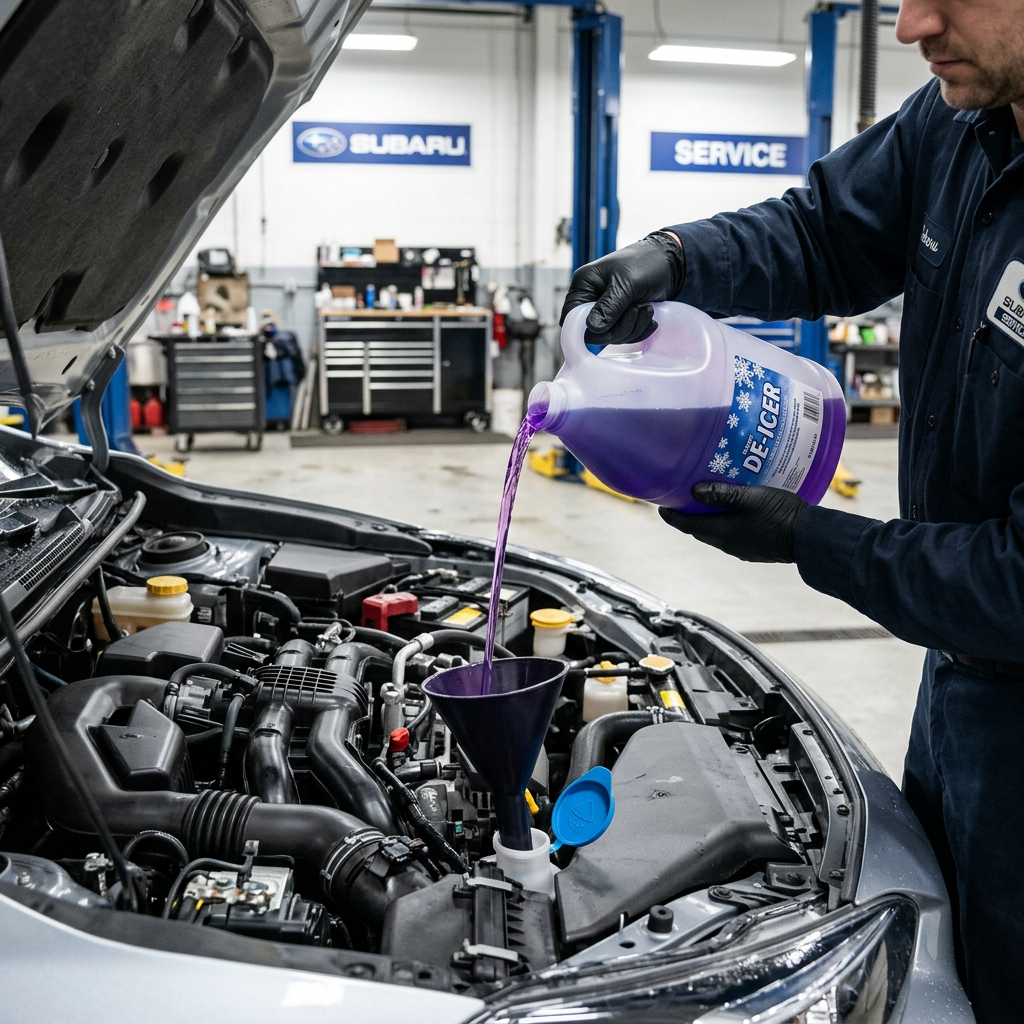
Professional winter de-icing fluids incorporate high concentrations of volatile alcohols (predominantly methyl alcohol/methanol, along with glycol ether wetting agents) calibrated to depress the freezing temperature down to -20°F or -30°F. When high-speed commercial freight traffic coats your glass in dense, salty road slurry on Route 59, winter fluid breaks the ionic surface tension of the road brine, dissolving greasy oil films and preventing ice build-up in fluid nozzle jets and washer pumps.
During professional winter preparation at Hawk Subaru, technicians evacuate leftover summer bug fluids from the reservoir lines before purging with extreme sub-zero de-icer. This prevents internal line freezing, split plastic reservoir bottles, and blown washer pump fuses during sudden Chicagoland temperature plummets.
Winter Wiper Blade Upgrades and Heating Defroster System Validation
Beam & Enclosed Blades
Traditional metal bridge-frame wiper blades rely on exposed metal joints and tension springs. In snowy conditions, slush packs tightly into these open linkages, freezing solid into a rigid bar that cannot conform to your windshield curve. Dedicated winter beam blades or rubber-booted wipers encapsulate the structural frame in a weather-tight synthetic rubber boot, preventing ice accumulation and maintaining uninterrupted squeegee contact pressure across every square inch of glass.
Rear Glass Grid Continuity
Rear defrosters use silver-ceramic conductive filament grids silkscreened onto the back glass. Over time, internal cargo shifting or abrasive tint removals create invisible hairline micro-fractures in the horizontal traces. Winterization involves digital millivolt continuity testing across every grid line to guarantee rapid snow clearing, alongside inspecting heated exterior mirror circuits and front wiper de-icer heating zones seated beneath the windshield park position.
HVAC Blend Door Motors
Defogging requires efficient cabin air dehumidification driven by the air conditioning compressor working in concert with the heater core. Technicians verify electronic blend-door actuator calibration, clean cabin air filtration elements to guarantee peak airflow velocity, and verify fresh-air intake mode operation to prevent recycled, moisture-laden cabin breath from persistently coating the windshield interior on cold morning commutes.
Tire Tread Depth, Cold PSI Fluctuations, and Symmetrical AWD Alignment
Tire pressure maintenance obeys Gay-Lussac’s gas law: contained air pressure drops by roughly 1 to 2 PSI for every 10°F drop in ambient temperature. When summer temperatures of 75°F transition into winter mornings hovering near 15°F, your tires lose 6 to 8 PSI without leaking a single molecule of air. Driving on under-inflated tires increases rolling resistance, elevates tread edge wear, and compromises internal belt stability. Technicians calibrate cold pressures to exact vehicle door-jamb placard specifications, factoring in seasonal ambient drops.
While the legal minimum tread wear limit in Illinois is 2/32 of an inch, this threshold applies primarily to dry asphalt. In wet slush and packed snow, a tire worn to 4/32 of an inch loses its ability to channel standing water away from the contact patch, causing hydroplaning at highway speeds. Winter inspections measure inner, center, and outer tread ribs with digital depth gauges, establishing 5/32 to 6/32 of an inch as the true minimum threshold for dependable winter driving safety.
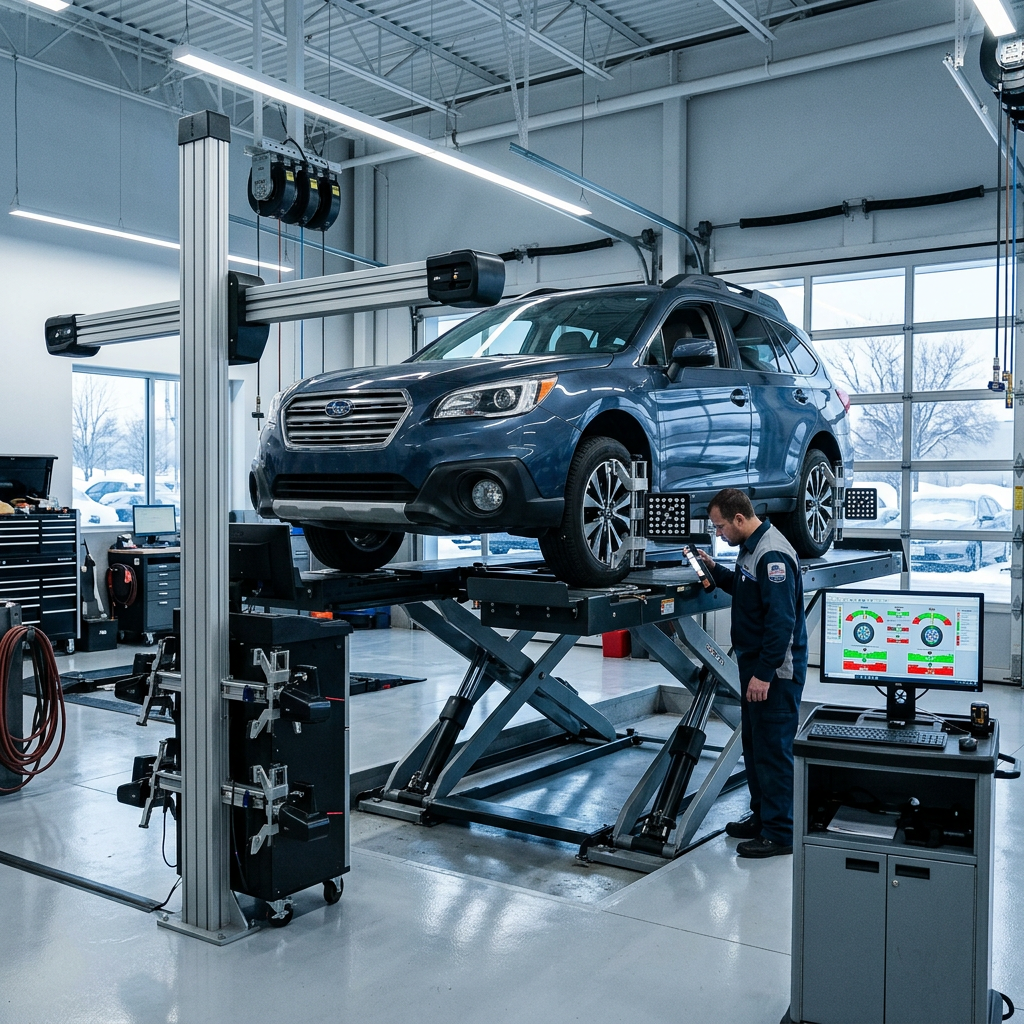
For Subaru Symmetrical All-Wheel Drive and other multi-clutch AWD systems, uniform tire circumference and four-wheel alignment precision are mandatory. Deviations in tread wear exceeding 2/32-inch across axles force internal center differentials and viscous couplers to slip constantly, generating excessive internal friction and heat. Precision computerized four-wheel thrust-angle alignment ensures your vehicle tracks straight across rutted, snow-packed suburban arterials.
What Does the 3-Peak Mountain Snowflake (3PMSF) Symbol Certify?
Many drivers assume that a tire stamped with the standard M+S (Mud and Snow) badge provides certified winter performance. In reality, the traditional M+S marking is merely an unverified manufacturer geometry claim indicating that the tread pattern features at least 25 percent open void area. It requires zero standardized empirical testing on ice, freezing asphalt, or hard-packed snow. The tire industry recognized this safety limitation and introduced the rigorous 3-Peak Mountain Snowflake (3PMSF) standard.
To earn the 3PMSF emblem, a tire must pass standardized, objective acceleration testing on medium-packed snow in accordance with the ASTM International F1805 standard. The candidate tire must demonstrate a minimum of 110 percent (10 percent superior) snow traction index compared to a standardized Standard Reference Test Tire (SRTT). This rigorous testing verifies that the tire delivers tangible traction gains under adverse winter road conditions.
The fundamental performance difference lies in rubber polymer chemistry. Standard all-season tire compounds possess a relatively high glass transition temperature (Tg). When ambient road surface temperatures fall below 45°F (7°C), all-season rubber hardens into a rigid, non-compliant state known colloquially as the 'hockey puck effect.' The stiffened tread blocks can no longer mold into the microscopic texture of cold asphalt, drastically reducing friction coefficients.
In contrast, 3PMSF winter tires incorporate high-dispersion silica compounds and specialized canola oil plasticizers that maintain molecular elasticity down to -30°F. Additionally, their tread blocks are cut with thousands of micro-thin 3D zig-zag sipes. As each tread block flexes under load, these sipes open to bite into snow, drawing moisture away from the contact patch and trapping packed snow crystals—utilizing snow-on-snow shear friction for outstanding road grip. Explore tire options and accessories through our Parts Center.
How Much Shorter Is Winter Tire Stopping Distance on Packed Snow and Black Ice?
Packed Snow Braking (35 mph)
On medium-packed snow at 35 mph, a typical all-wheel-drive passenger crossover equipped with standard OEM all-season tires requires an average of 145 to 160 feet to come to a complete emergency stop. Swapping to dedicated 3PMSF winter tires slashes that stopping distance to approximately 105 to 115 feet—a 30 to 35 percent reduction. That difference of 35 to 45 feet represents two to three full vehicle car lengths, easily preventing a rear-end collision at a signalized Plainfield intersection.
Black Ice Deceleration (20 mph)
Black ice presents the most hazardous friction coefficient in surface transportation, dropping tire-to-road friction from 0.85μ (dry pavement) down to an alarming 0.08μ–0.12μ. At just 20 mph, an all-season tire slides up to 100 feet or more before ABS can arrest forward momentum. Winter tires with hydrophilic multi-cell compounds absorb the microscopic boundary water layer that lubricates ice, cutting stopping distances down to 60–70 feet and preserving steerability.
The All-Wheel Drive Myth
Many drivers mistakenly believe that having advanced All-Wheel Drive eliminates the need for winter rubber. AWD provides superior forward tractive effort during acceleration by delivering engine torque across all four wheels, but it offers zero assistance once the vehicle is under hard braking. Every modern production vehicle already features four-wheel disc braking. Your stopping distance is dictated solely by the frictional coefficient of your four tire contact patches.
Brake System Hydration, Rotor Wear, and Undercarriage Corrosion Shielding
Hydraulic brake fluid (DOT 3 and DOT 4) is inherently hygroscopic, drawing atmospheric moisture through microscopic pores in flexible rubber brake hoses and fluid reservoir seals. Within two to three years of real-world driving, brake fluid water concentration commonly surpasses 3.5 to 4 percent. This moisture absorption depresses the fluid's wet boiling point from approximately 401°F down toward 284°F, introducing risks of hydraulic vapor lock under repeated braking.
In sub-zero Illinois weather, entrained water creates an even more immediate operational hazard: microscopic moisture droplets can separate, freezing into ice crystals inside delicate anti-lock brake system (ABS) solenoid valves and electronic stability control (ESC) proportioning manifolds. This can yield a stiff, unyielding brake pedal, delayed hydraulic pressure response, or dragging calipers. Technicians evaluate brake fluid water content using optical refractometers and conduct complete hydraulic flushes when moisture exceeds 2 percent.
Equally threatening to vehicle longevity is the modern chemical road de-icing formulation utilized by the Illinois Department of Transportation (IDOT). Traditional dry rock salt has been replaced by highly corrosive liquid magnesium chloride and calcium chloride brines infused with agricultural anti-sticking wetting agents. These liquid brines adhere aggressively to undercarriage frames, unpainted cast-iron brake rotor hats, stamped steel suspension control arms, and electronic ABS wheel-speed sensor harnesses.
A comprehensive winterization package lubricates exposed caliper floating slide pins and stainless-steel abutment clips with high-temperature, synthetic silicone ceramic paste. This prevents salt-crust corrosion from seizing caliper movement, which causes uneven brake pad tapering, severe rotor scoring, and drag. Routine high-pressure undercarriage washing with specialized salt-neutralizing detergents forms a vital protective maintenance barrier against structural rust.
Chicagoland Holiday Highway Prep: Essential I-55 and I-80 Winter Driving Checklist
Northeastern Illinois highway travel during Thanksgiving, Christmas, and New Year holidays presents challenging driving environments. Sudden lake-effect squalls and heavy commercial tractor-trailer traffic across the Plainfield, Joliet, and Naperville corridors can turn expressways into gridlocked, low-visibility zones within minutes. Proper preparation protects your vehicle and family against hazardous conditions.
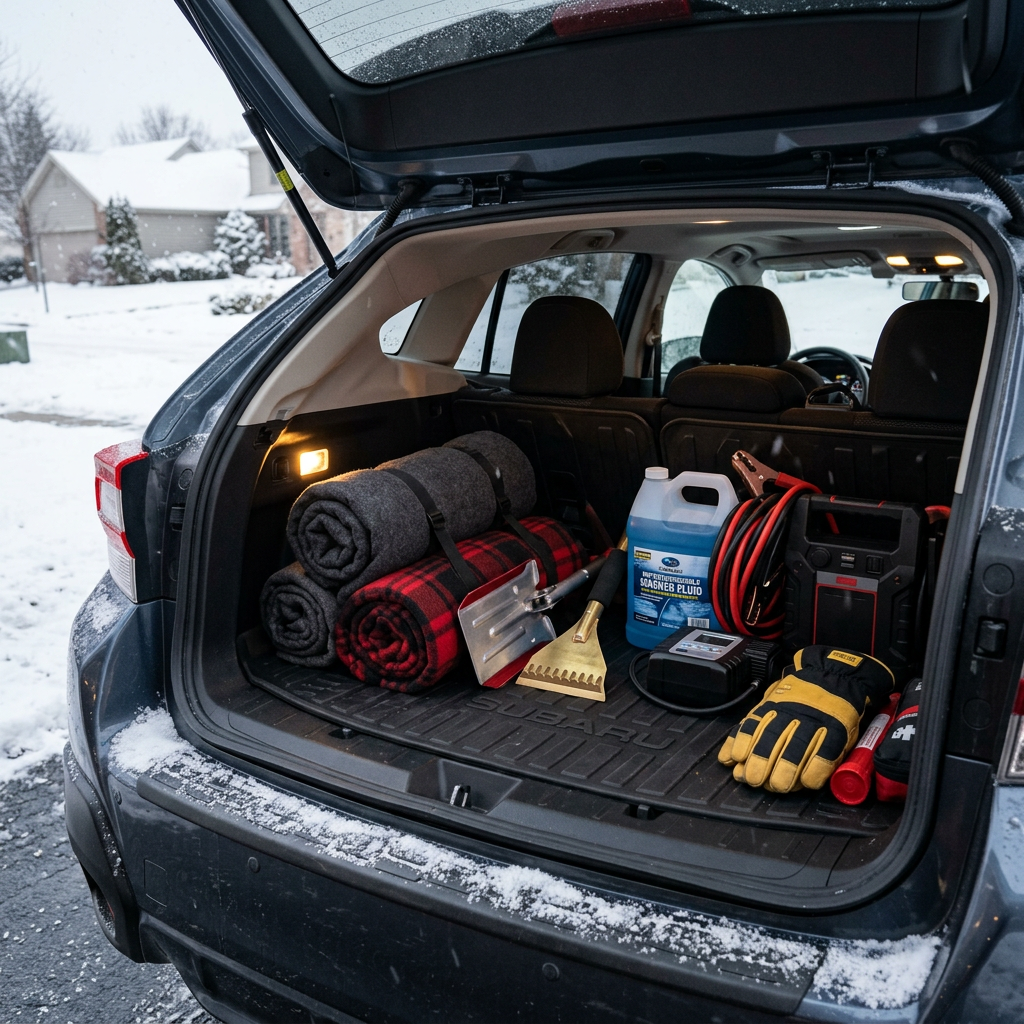
Fluids & Fuel Baseline
Never allow your fuel tank to drop below half full during winter travel. In sub-freezing temperatures, excessive air headspace in a fuel tank promotes water vapor condensation. This moisture settles to the tank bottom and enters fuel lines, causing fuel-line ice freeze-ups and fuel pump cavitation. Keep an extra jug of -30°F rated de-icing washer solvent securely stowed in your cargo hold.
Emergency Power & Recovery
Carry a charged lithium-ion emergency jump starter pack (rated at 1000+ peak amps) along with 4-gauge heavy-duty copper jumper cables. Cold battery voltages diminish quickly in sudden winter weather. Include a dynamic kinetic recovery tow strap, high-output LED road flares, a digital tire pressure gauge, and a 12-volt portable air compressor to manage temperature-induced PSI drops on the go.
Thermal Survival Gear
Pack heavy wool thermal blankets or sub-zero sleeping bags, waterproof insulated work gloves, thermal hats, hand warmers, non-perishable high-calorie food, and a 20-pound bag of coarse clay cat litter or traction sand. A compact, collapsible aluminum snow shovel and brass-blade ice scraper allow you to clear drifted snow away from tires and engine intakes if you become stranded.
What Should I Do If My Vehicle Becomes Disabled on an Illinois Tollway in Winter?
Experiencing a mechanical failure, blown tire, or running out of fuel along the Illinois Tollway system (I-88, I-355, I-294) or regional freeways like I-55 and I-80 is dangerous, particularly during blinding winter conditions. If engine power allows, immediately activate your hazard warning flashers and ease your vehicle onto the right-side shoulder, positioning the car as far away from active traffic lanes as possible. If an interchange ramp or service plaza is within gliding distance, always exit the main highway corridor completely.
From your mobile device, immediately dial *999 to connect directly with the Illinois Tollway Highway Emergency Lane Patrol (H.E.L.P.) dispatch center. These specialized roadway assistance units patrol tollways continuously during winter storms, equipped with booster cables, emergency fuel, air compressors, and heavy crash attenuators to shield stranded motorists. Note your precise milepost marker, travel direction, and the closest overpass to ensure prompt dispatch.
Remain inside your vehicle with your seatbelt buckled. In sub-zero whiteout conditions, other drivers can lose directional control and slide along the road shoulder; standing outside your vehicle puts you at grave risk. If you must keep the engine running to power your cabin heater while awaiting assistance, you must first exit briefly to confirm that the vehicle tailpipe is completely clear of packed snow or ice drifts. A blocked exhaust pipe will force lethal carbon monoxide back into the passenger cabin within minutes.
Operate the engine only intermittently—approximately 10 minutes every hour—to conserve battery and fuel reserves while maintaining tolerable interior thermal conditions. Crack a downwind window slightly to guarantee continuous fresh air exchange. Keep your interior dome light illuminated at night so snow plow operators and emergency units can easily spot your vehicle along dark shoulders.
Schedule Your Complete Winterization Service Package in Plainfield
Do not wait until the first severe Midwestern blizzard strands your vehicle in freezing weather. At Hawk Subaru, our certified factory-trained service technicians specialize in winterizing cars, crossovers, and SUVs for drivers throughout Plainfield, Joliet, Naperville, and the surrounding Chicagoland area. Our winterization package incorporates genuine OEM battery replacements, digital conductance load testing, precision optical coolant refractometry, heavy-duty winter wiper installations, and complete AWD tire and alignment inspections. Whether you need certified winter tires mounted, brake fluid flushed, or your heating and defrosting circuits validated, our dedicated team has the factory diagnostic tools and genuine parts required to safeguard your winter drives. Get Directions to Hawk Subaru at 2401 Rte 59 in Plainfield, or contact our service advisors directly by phone at Call (815) 725-3789.