Subaru Symmetrical AWD vs. Honda Real Time AWD: The Direct Comparison
When searching for the ideal crossover or SUV to handle northern Illinois weather, all-wheel drive performance sits at the top of most drivers' priority lists. From unpredictable snowstorms in Plainfield to torrential downpours on Interstate 55 near Naperville and Joliet, having a reliable traction management system provides essential peace of mind. However, not all all-wheel drive systems are created equal. The foundational engineering philosophies behind Subaru's Symmetrical All-Wheel Drive and Honda's Real Time AWD with Intelligent Control System™ represent two fundamentally different approaches to four-wheel traction.
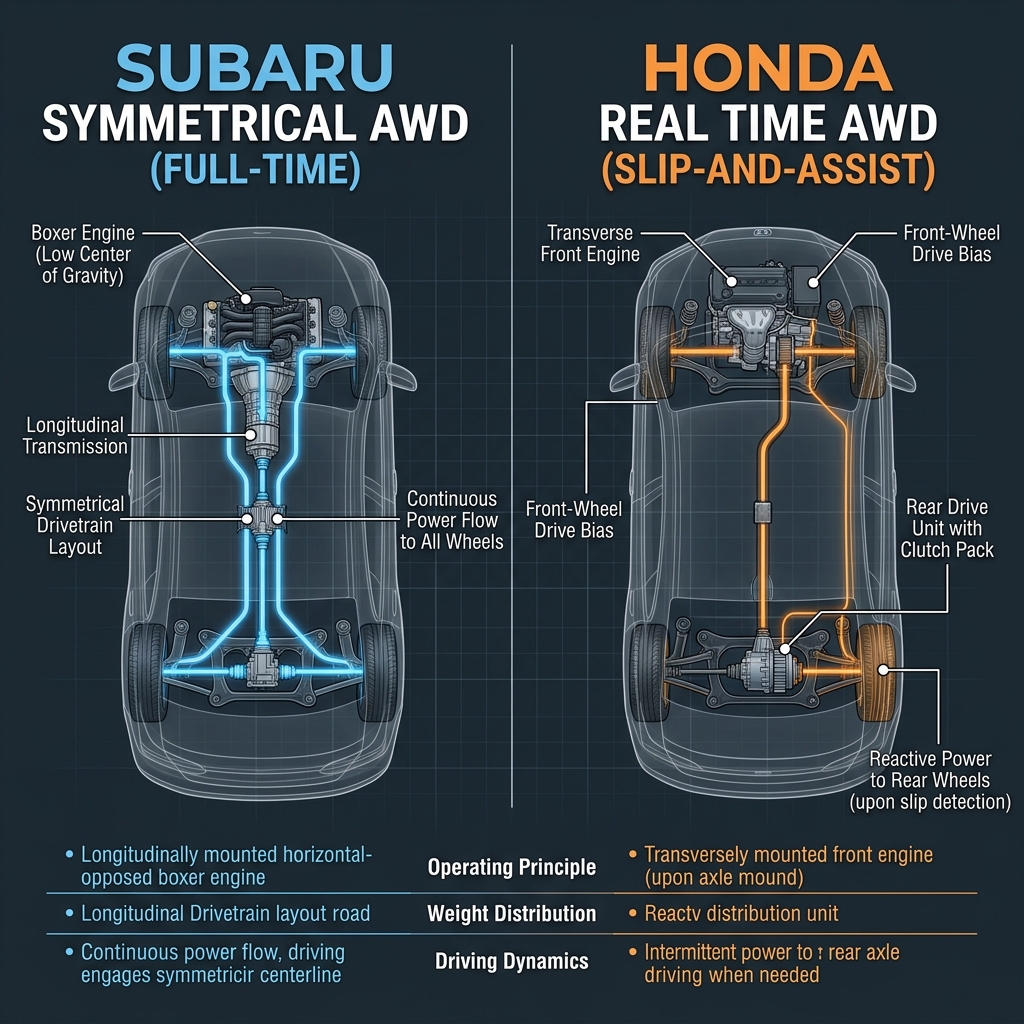
In short: Subaru Symmetrical AWD is a continuous, full-time system that sends power to all four wheels 100% of the time. In contrast, Honda's Real Time AWD is primarily a reactive, slip-and-assist system that operates as a front-wheel drive vehicle under normal conditions and only routes power to the rear wheels after front-wheel slippage is detected or predicted by electronic sensors. Understanding these mechanical distinctions is crucial for drivers who demand consistent vehicle control, balanced handling dynamics, and superior cold-weather safety.
|
Core Feature
|
Subaru Symmetrical AWD
|
Honda Real Time AWD
|
|
Operating Mode
|
Full-Time Continuous Engagement
|
Part-Time / Disconnect Reactive Engagement
|
|
Default Power Split
|
Continuous 60:40 or 50:50 (Front:Rear)
|
100:0 (Front:Rear) until slip is detected
|
|
Drivetrain Architecture
|
Linear, Symmetrical Layout with Boxer Engine
|
Transverse Engine with Offset Driveshafts
|
|
Center of Gravity
|
Ultra-low, horizontally balanced center line
|
Higher, traditional upright engine positioning
|
|
Traction Response Time
|
Instantaneous (Continuous power delivery)
|
Delayed (Requires mechanical/electronic clutch engagement)
|
|
Severe Snow Performance
|
Exceptional stability, pre-emptive grip
|
Moderate grip, reliant on slip-activation
|
For suburban commuter routes across Plainfield and Naperville, Subaru's continuous torque distribution prevents wheelspin before it starts. Honda's system, while efficient for mild climates, introduces a physical delay during power transfer that can leave drivers feeling momentarily hesitant on slick icy intersections or deep snow drifts.
Mechanical Architecture: Full-Time Symmetrical AWD vs. Slip-and-Assist AWD
Subaru Symmetrical Drivetrain Engineering
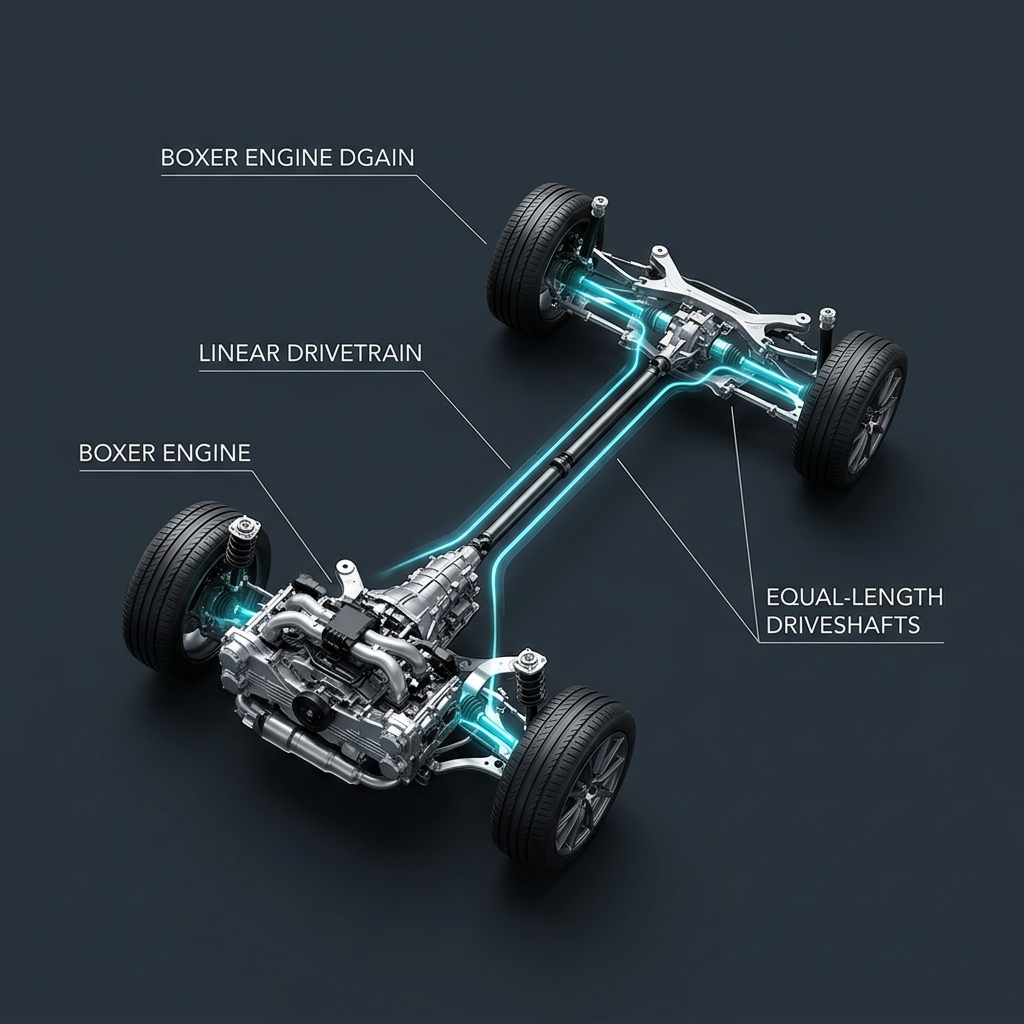
The genius of Subaru's Symmetrical All-Wheel Drive begins with the horizontally opposed Subaru BOXER® engine. Because the pistons move side-to-side rather than vertically, the entire powertrain sits significantly lower in the chassis. This creates an exceptionally low center of gravity, directly enhancing cornering stability, high-speed tracking, and body roll control.
Furthermore, the entire drivetrain—from the engine to the transmission, center differential, and rear axle—is laid out in a straight, linear, and perfectly symmetrical line down the center of the vehicle. Right and left driveshafts are equal in length, eliminating torque steer and ensuring balanced power transfer to all four wheels at all times. Whether accelerating on dry pavement or pushing through slush on Route 59, power is already present at every wheel hub.
Honda Transverse Slip-and-Assist Drivetrain
Honda's Real Time AWD system utilizes a conventional front-wheel drive platform with a transversely mounted inline engine. To power the rear wheels, a transfer case redirects kinetic energy through an asymmetrical propshaft to an multi-plate clutch system attached to the rear differential.
Under standard cruising conditions, this rear clutch remains completely disengaged. The vehicle operates purely as a front-wheel drive automobile to minimize drivetrain friction. When the wheel speed sensors detect front tire slip, hydraulic or electric actuators pressurize the clutch pack to direct a portion of power (up to 50%) to the rear wheels. While effective for fuel economy, this architecture requires continuous sensor calculation and physical clutch lockup, resulting in a measurable delay during critical traction events.
Additionally, the higher vertical height of the transverse engine creates a higher center of gravity, making the vehicle more susceptible to weight transfer and body lean during sudden evasive maneuvers on slick roads.
Navigating Plainfield & Naperville Winters: How Each System Handles Snow and Ice
Winter driving in Will and DuPage Counties presents unique challenges: freezing rain along Route 126, deep drifts in unplowed Plainfield subdivisions, and polished ice patches at busy stoplights along 75th Street in Naperville. In these demanding conditions, the fundamental difference between continuous and reactive AWD becomes immediately obvious.
Because Subaru Symmetrical AWD continuously delivers engine power to both the front and rear axles, every tire is already engaged when you press the accelerator pedal. When pulling out onto a slippery arterial street like Route 59, a Subaru Forester or Outback accelerates smoothly without initial wheel spinning. The vehicle stays aligned with your intended steering direction, eliminating tail-wagging or front-end plow.
Conversely, a Honda CR-V equipped with Real Time AWD begins accelerating strictly using its front tires. On an icy incline or polished intersection, those front tires must lose traction first before the electronic control unit commands the rear clutch to engage. This brief fraction of a second can cause the front end to break traction, triggering traction control brake intervention that bogs down engine power.
On high-speed snow-covered highways like I-55, Subaru's continuous 4-wheel tracking maintains exceptional directional stability when changing lanes over snow ruts or slush ridges. The continuous mechanical grip instills total driving confidence, allowing you to maintain calm control through northern Illinois' harsher winter weather.
Off-Road Traction Control: Subaru X-Mode vs. Honda i-VTM4 & TrailSport Systems
Subaru Dual-Function X-MODE®
Subaru's X-MODE® optimizes engine output, transmission ratio, center differential lockup, and VDC (Vehicle Dynamics Control) braking. Dual-function settings include 'Snow/Dirt' for slippery packed surfaces and 'Deep Snow/Mud' which allows controlled wheel spin to fling away thick mud or soft snow, maintaining forward momentum.
Honda i-VTM4 & TrailSport
Honda offers its advanced i-VTM4® torque-vectoring system on larger models like the Pilot and Passport TrailSport. However, the popular Honda CR-V uses a simplified Real Time AWD clutch pack without active rear torque vectoring, leaving compact Honda crossover buyers with limited off-road and deep-snow capabilities.
Hill Descent & Low-Speed Control
Subaru includes Hill Descent Control standard with X-Mode, automatically managing braking on steep, slippery declines so the driver can focus entirely on steering. Subaru Wilderness models add enhanced low-gear crawl ratios capable of conquering steep gravel grades and unpaved forest trails.
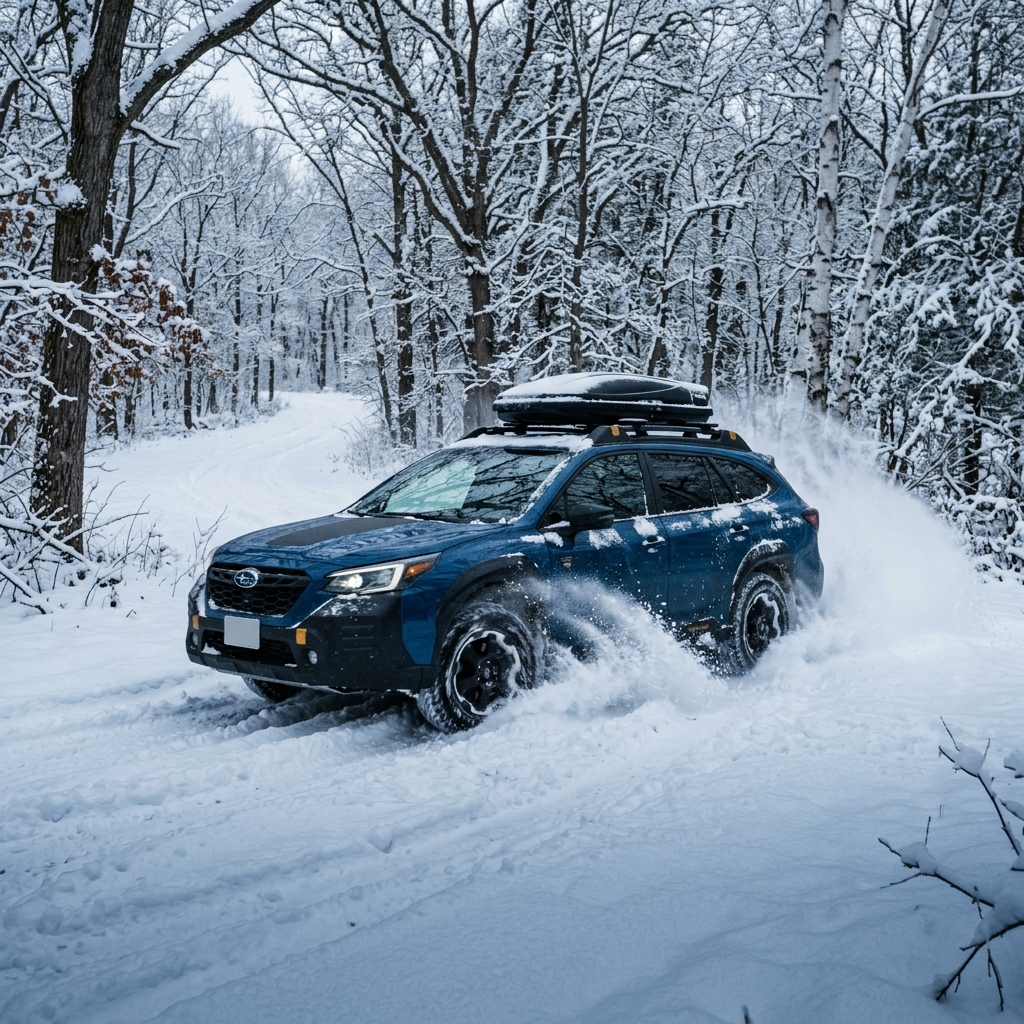
Interested in exploring the capability of Subaru Symmetrical AWD and X-Mode in person? Check our current vehicle selection to find your next adventure-ready crossover.
Fuel Economy vs. Traction Confidence: Is Honda's Disconnect System Worth the Trade-off?
The Fuel Disconnect Mileage Comparison
A common argument in favor of slip-and-assist systems like Honda's is fuel savings. By disconnecting the rear axle during highway cruising, the powertrain eliminates rotational drag from the rear differential and driveshafts. However, modern engineering advancements in Subaru's Lineartronic® CVT and active torque split algorithms have virtually eliminated this efficiency gap.
Comparing EPA ratings between the Subaru Forester AWD and Honda CR-V AWD reveals an almost negligible difference of approximately 1 MPG on the highway. Subaru achieves exceptional fuel efficiency while maintaining continuous active mechanical coupling to all four wheels.
The Uncompromising Safety Dividend
Is saving a fraction of a gallon of fuel per tank worth giving up permanent four-wheel stability? During severe Midwest thunderstorms or sudden winter squalls along I-80, hydroplaning and sudden loss of grip occur in milliseconds—far faster than an electronic rear-clutch actuator can react.
Because Subaru Symmetrical AWD continuously distributes torque, the chassis remains balanced and grounded through gusting side winds, standing water, and black ice. The slight efficiency tradeoff yields a massive dividend in real-world driver safety, control, and peace of mind.
What Trim Levels Are Available on the 2027 Subaru Forester?
The 2027 Subaru Forester lineup offers a versatile selection of trim levels designed to match various lifestyle preferences, driving habits, and budgets. Crucially, every single 2027 Forester trim comes standard with Subaru's full-time Symmetrical All-Wheel Drive system—unlike the Honda CR-V, where front-wheel drive is standard on lower trims and AWD requires an expensive optional upgrade.
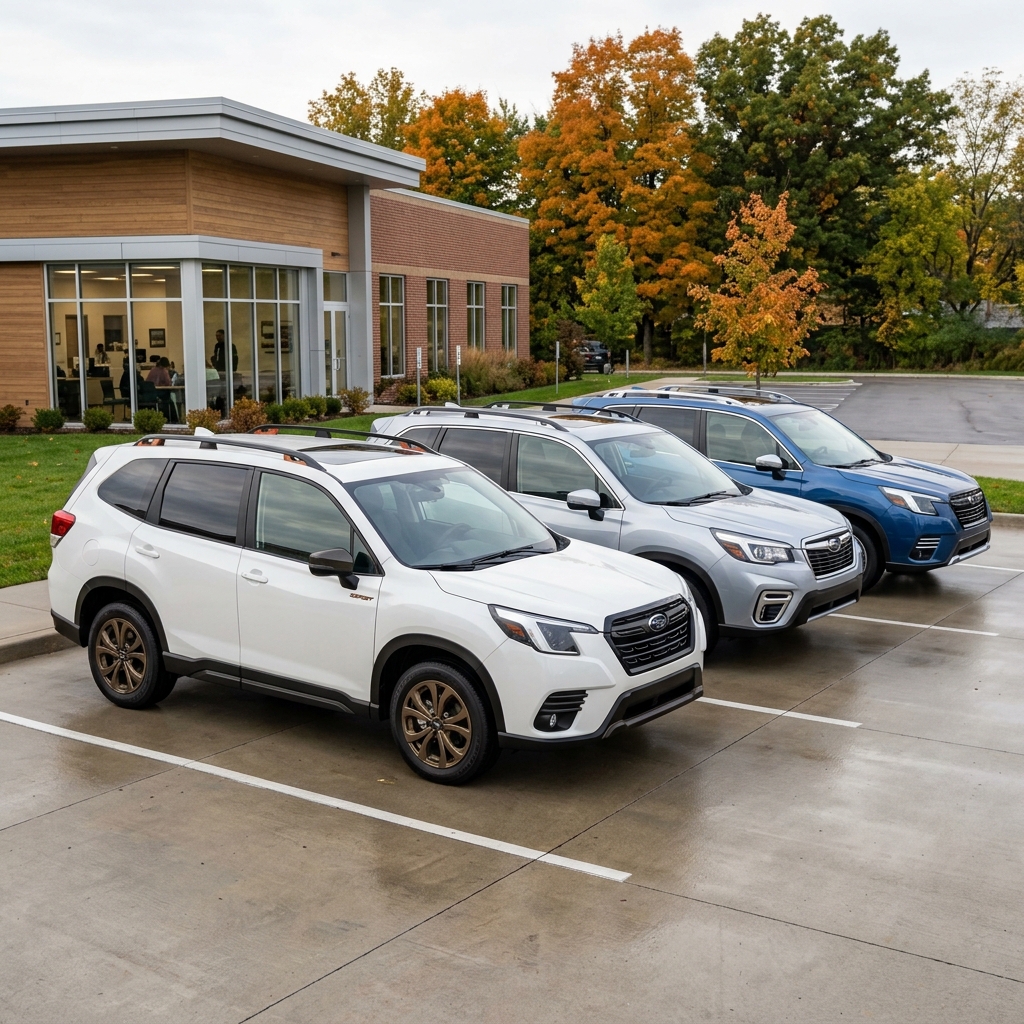
2027 Subaru Forester Trim Hierarchy:• Base: Includes standard Symmetrical AWD, dual-zone automatic climate control, EyeSight® Driver Assist Technology, and LED Steering Responsive Headlights. • Premium: Adds 11.6-inch STARLINK® multimedia, keyless access, heated front seats, panoramic moonroof, and available blind-spot detection. • Sport: Features distinctive bronze exterior accents, 19-inch bronze-finish alloy wheels, StarTex® water-repellent upholstery, and Dual-Function X-MODE®. • Limited: Upgrades to leather-trimmed seating, power rear gate, heated steering wheel, and enhanced driver assistance features. • Touring: The pinnacle of luxury with two-tone leather trim, heated/ventilated front seats, surround-view monitor, and Harman Kardon® premium audio.
|
Trim Feature
|
2027 Subaru Forester
|
Honda CR-V
|
|
Standard AWD
|
Yes (All Trims Standard)
|
No (Optional on LX, EX, EX-L)
|
|
Advanced Off-Road Mode
|
Dual-Function X-Mode (Sport+)
|
Basic Snow Mode Only
|
|
Roof Rail Capacity
|
Up to 800 lbs static (Wilderness/Sport)
|
165 lbs max
|
What Is the Ground Clearance on the 2027 Subaru Forester Compared to Honda CR-V?
Standard Specifications & Off-Road Geometry
Ground clearance is vital when driving through deep winter snowdrifts, frozen ruts, or unpaved forest trail roads. The 2027 Subaru Forester sets the benchmark in its class with a generous 8.7 inches of standard ground clearance across its core trim lineup, with Forester Wilderness models elevating clearance even higher to 9.2 inches.
By comparison, the Honda CR-V offers a maximum ground clearance of only 8.2 inches on AWD models, while standard front-wheel drive CR-V trims sit lower at 7.8 inches. That half-inch to full-inch advantage in the Forester provides critical clearance over high-centered snow packed by plows at suburban Plainfield driveway entrances.
Approach, Breakover, and Underbody Protection
Superior ground clearance is paired with optimized body geometry. The 2027 Forester engineered short front and rear overhangs to deliver steep approach, ramp breakover, and departure angles. This prevents the front bumper or rear exhaust tips from scraping when pulling out of steep drainage dips or navigating unpaved rural trails.
Furthermore, Subaru shields vital drivetrain components—such as the oil pan and center differential—with protective underbody cladding, ensuring long-term durability when tackling rough Midwest terrain.
Resale Value & Durability: Which Subaru Model Holds Its Value Best Over Time?
Subaru Outback Residual Leadership
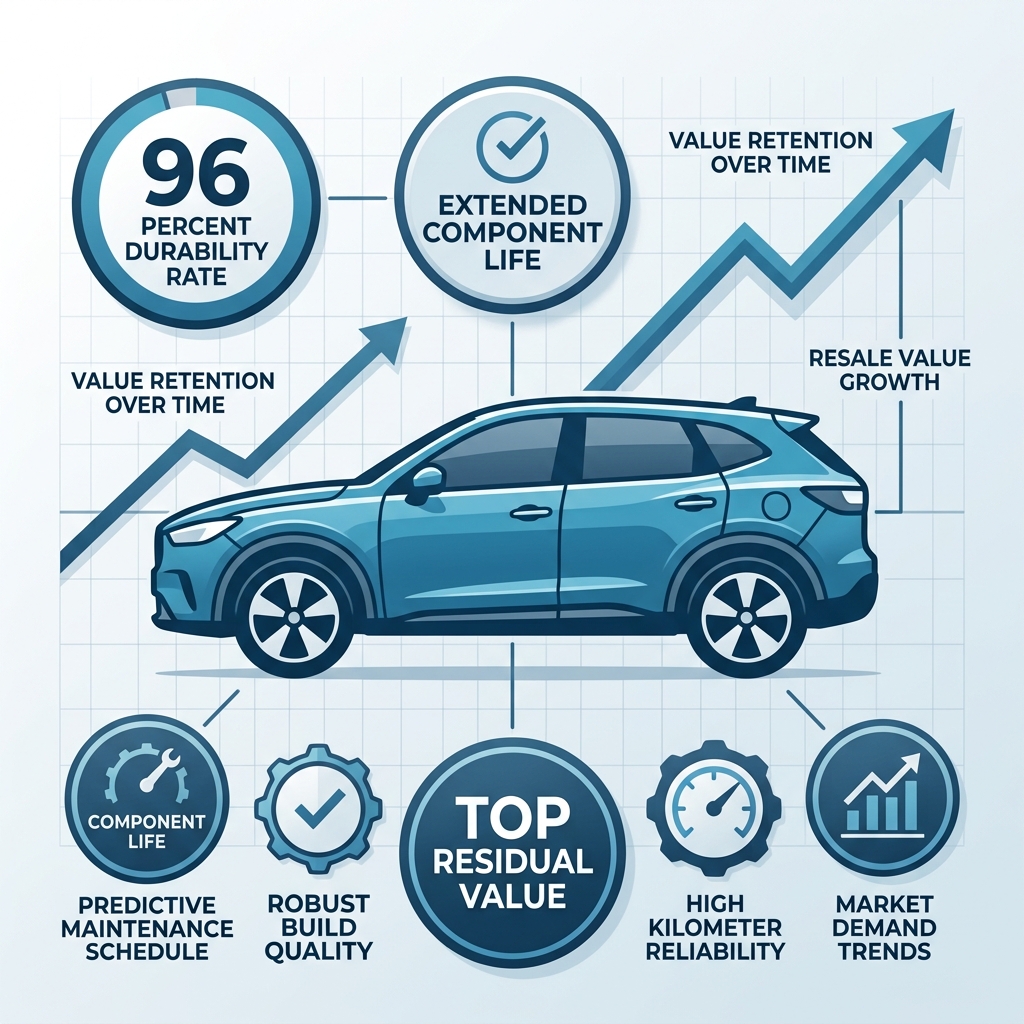
The Subaru Outback consistently ranks at the top of Kelley Blue Book and ALG residual value charts. Its combination of rugged station-wagon utility, standard full-time AWD, and proven durability keeps used market demand remarkably high.
Subaru Forester Retained Value
Matching the Outback, the Forester retains an extraordinarily high percentage of its original purchase price after 36 and 60 months. Midwest buyers actively seek pre-owned Foresters for their winter capability, preserving trade-in value.
Subaru Crosstrek Value Retention
The compact Crosstrek frequently claims top honors for overall resale value in the subcompact SUV segment. Its rugged build and standard AWD make it a highly coveted choice for commuters throughout the Chicagoland region.
Are Extended Protection Plans Available from Subaru Dealerships?
Subaru Added Security® Factory Protection
Yes, Hawk Subaru offers official Subaru Added Security® extended service agreements. Unlike third-party warranty programs that often utilize aftermarket remanufactured parts or impose frustrating claim restrictions, Subaru Added Security is backed directly by Subaru of America, Inc.
Plans are available in two primary coverage tiers: • Powertrain Protection: Covers essential mechanical engine components, Symmetrical AWD center differential, front and rear differentials, CV joints, and transmission assemblies. • Gold Plus Coverage: Exclusively comprehensive protection covering virtually every mechanical and electronic system, including EyeSight® sensors, STARLINK® infotainment systems, and advanced climate controls.
Key Benefits & Dealer Protection Perks
Choosing an authorized factory extended protection plan ensures your vehicle receives genuine Subaru OEM parts installed by factory-certified technicians. Key plan benefits include: • $0 or nominal deductible options per service visit • 24/7 Roadside Assistance, including towing, flat tire changes, and jump-starts • Rental car allowance and trip-interruption reimbursement during warranty repairs • Transferable coverage that increases vehicle resale value if sold privately
AWD Maintenance & Service Needs Near Joliet and Plainfield, IL
Essential Maintenance for Continuous AWD
To maintain optimal performance and longevity from Subaru's Symmetrical AWD system, routine maintenance is essential. Key service tasks include differential fluid inspections, regular tire rotations, and CV axle boot checks.
Critical Tip — Matched Tire Circumference: Because continuous AWD actively engages all four wheels, tire tread depth must remain uniform across all four tires (within 2/32nds of an inch). Rotating tires every 6,000 miles prevents uneven tread wear and protects center differential components from strain.
Hawk Subaru Service Center
Drivers in Plainfield, Joliet, Naperville, and Shorewood rely on the Hawk Subaru Service Center for expert maintenance. Our state-of-the-art facility features Subaru Master Technicians equipped with specialized diagnostic tools and genuine OEM fluids designed specifically for Boxer engines and Symmetrical AWD differentials.
Where Is the Subaru Dealership in Plainfield, IL, and How Can I Contact It?
Hawk Subaru Location & Details
Hawk Subaru is conveniently located in Plainfield, IL, serving local drivers across Will and DuPage Counties with exceptional sales, leasing, and certified service. Address: 2401 Rte, 59, Plainfield, IL 60586 Phone Contact:Call us at (815) 725-3789Get Directions: Get Directions to Hawk Subaru
Easy Access from Neighboring Cities
• From Naperville: Head south on Route 59 directly into Plainfield. Our dealership is located on the east side of Route 59. • From Joliet: Take I-55 North to Exit 257 for Route 59, heading north toward Plainfield. • From Shorewood / Minooka: Take Ridge Road north to Caton Farm Road, turn east toward Route 59. Ready to get started on financing before your visit? You can Get Pre-Approved for Financing online in minutes.
Experience Subaru Symmetrical AWD at Hawk Subaru in Plainfield, IL
While specs on paper illustrate the mechanical superiority of Subaru Symmetrical AWD over Honda Real Time AWD, nothing replaces the feeling behind the wheel. Whether you are navigating an icy morning commute down Route 59 or taking a weekend road trip across Illinois, Subaru provides unmatched traction, continuous safety, and confident handling.
Visit Hawk Subaru today in Plainfield, IL to test drive the 2027 Subaru Forester, Outback, Crosstrek, or Ascent. Experience full-time all-wheel drive confidence firsthand!