Why Full-Time Subaru Symmetrical AWD Outperforms Slip-and-Grip Systems
When driving through an unexpected Northern Illinois autumn downpour or navigating icy slush on Route 59, the fraction of a second between losing grip and regaining control can determine whether you maintain your lane safely or experience an unsettling skid. This critical threshold highlights the fundamental engineering distinction between full-time all-wheel drive and part-time dynamic systems. Subaru Symmetrical All-Wheel Drive operates on a proactive, continuous philosophy: power is distributed actively to all four wheels 100% of the time. By delivering drive torque continuously across the entire vehicle chassis, Subaru eliminates the lag inherent in competitive systems and prevents traction loss before it begins.
In stark contrast, the vast majority of modern crossovers and compact SUVs utilize front-wheel-drive-biased, part-time systems often called "slip-and-grip" or reactive AWD. Under normal conditions, these vehicles direct up to 100% of engine power exclusively to the front axle to conserve fuel. Power is directed to the rear wheels only after electronic sensors detect wheelspin at the front. While this reactive mechanical setup looks impressive on a showroom brochure, it introduces a physical delay—requiring front tire slippage before rear drive torque engages. At Hawk Subaru in Plainfield, we take pride in helping drivers understand how Subaru's linear, permanent powertrain architecture delivers predictable handling, immediate throttle response, and unyielding safety under all driving conditions.
What Is Subaru Symmetrical All-Wheel Drive and How Does It Work?
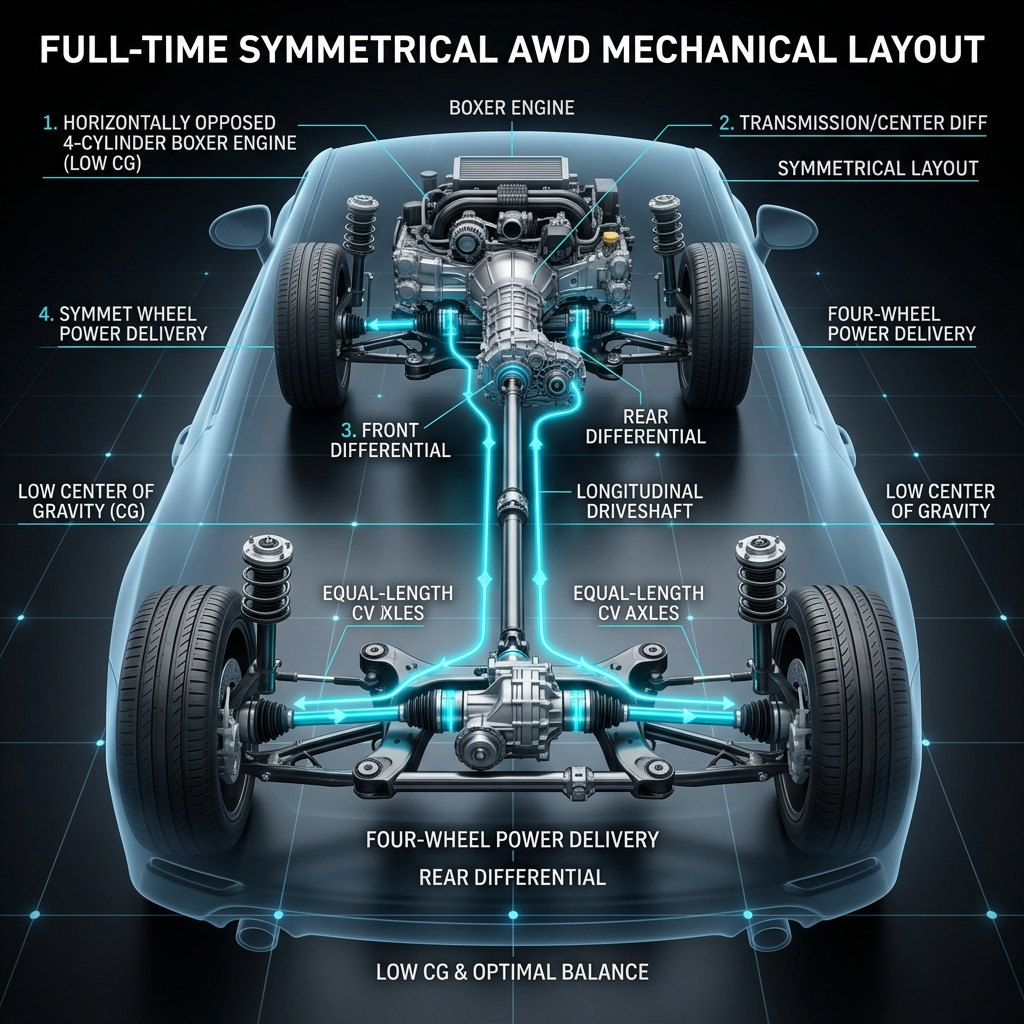
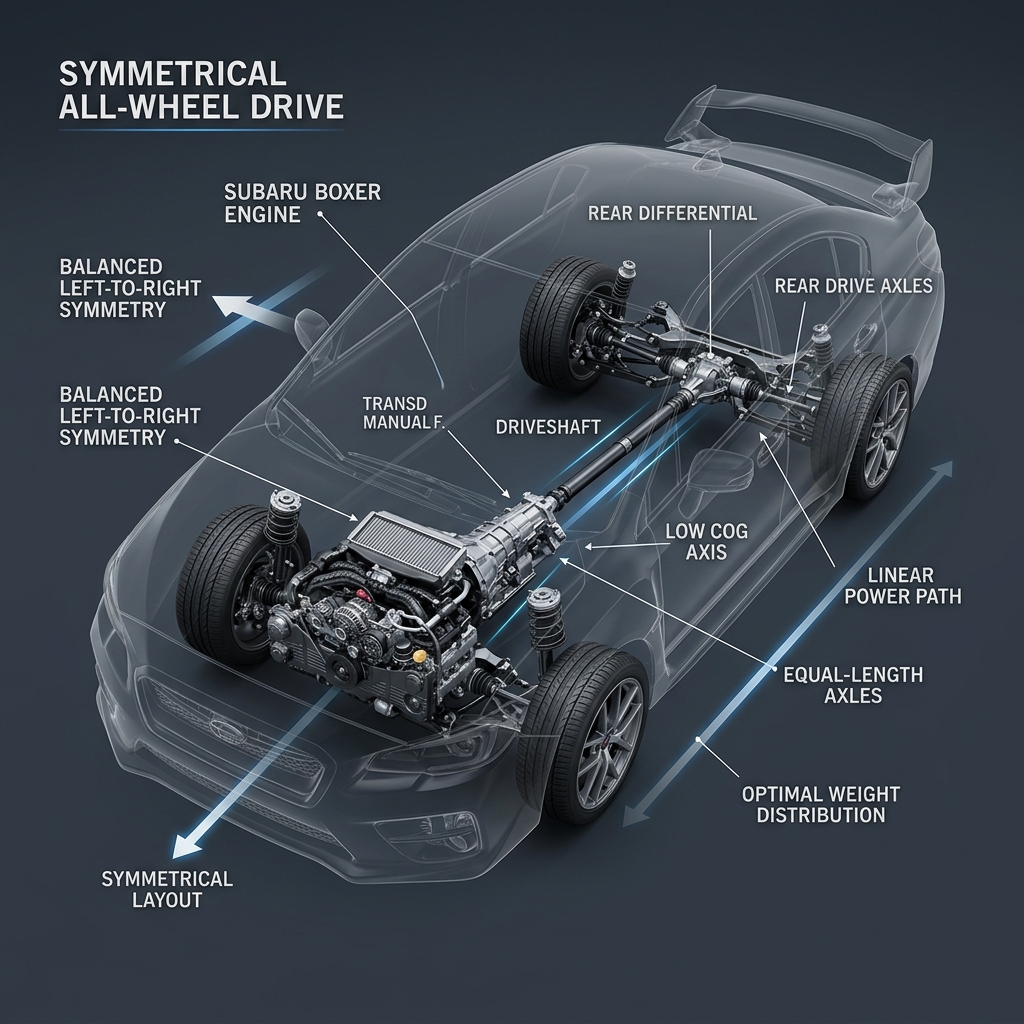
Subaru Symmetrical All-Wheel Drive is not an add-on module bolted onto a front-wheel drive platform; it is a holistic mechanical design philosophy integrated into the core architecture of the vehicle. The cornerstone of this system is the longitudinally mounted Subaru BOXER® engine, which features horizontally opposed pistons. Positioned inline with the transmission along the vehicle's centerline, this engine layout creates a perfectly balanced, mirror-image powertrain from front to rear.
Because power flows in a straight line from the horizontally opposed engine through the transmission directly into the center differential and equal-length front and rear driveshafts, torque transfer is exceptionally efficient. There are no right-angle gear transfers or complex transverse offset belts required to redirect rotational energy to auxiliary drive axles. This linear drivetrain path maximizes mechanical efficiency, minimizes power loss, and ensures that engine torque is continuously split between the front and rear axles during every moment of driving.
Furthermore, the low profile of the BOXER engine sits deep within the engine bay, dramatically lowering the vehicle's center of gravity. Combined with equal-length front half-shafts, Subaru vehicles resist body roll naturally without requiring overly rigid suspension dampening, providing smooth ride comfort alongside razor-sharp traction feedback.
How Slip-and-Grip AWD Systems Function and Where They Fall Short
To understand the competitive edge of Subaru AWD, it helps to examine how conventional part-time all-wheel drive systems function in everyday crossovers. Most vehicle manufacturers construct their small and midsize utility vehicles on standard front-wheel-drive platforms equipped with transversely mounted inline engines. In these setups, the engine sits sideways across the engine bay, sending 100% of its torque to the front wheels during normal dry-pavement cruising.
When a front wheel loses traction on ice, wet leaves, or loose gravel, wheel-speed sensors alert an electronic controller. This controller signals an electromagnetic or hydraulic clutch pack attached to the rear differential, clamp-engaging to route partial power to the rear axle. While effective for basic light-duty needs, this sequence requires a physical cycle: Slip occurs → Sensor registers → Computer processes → Hydraulic clutch clamps → Power transfers.
This mechanical latency creates substantial drawbacks during crucial driving moments. First, because power transfer only begins after slip occurs, momentum has already been compromised and the tires have broken static friction. Second, sudden engagement of the rear axle mid-corner can disrupt chassis balance, causing unpredictable shifts between understeer and oversteer.
In extreme low-friction situations—such as climbing a snow-covered incline in Will County—clutch-based slip-and-grip systems can quickly overheat under continuous slipping conditions. When thermal limits are reached, electronic safeguards automatically disengage the rear axle altogether, leaving the driver stuck in two-wheel drive precisely when full-wheel traction is needed most.
Comparing Traction: Instantaneous Torque vs. Delayed Reaction Time
Acceleration & Launch Stability
Accelerating from a complete stop on slick or unpaved surfaces requires uniform power distribution. Subaru's full-time system delivers engine torque to all four contact patches instantaneously, preventing tire spin before it begins. Slip-and-grip systems suffer initial wheel spin at the front, causing traction control intervention that cuts engine power and degrades forward momentum.
Cornering Precision & Control
Maintaining vehicle trajectory around curved highway ramps or sharp turns relies on continuous tire lateral adhesion. Subaru's active power split matches throttle inputs continuously with steering angle, keeping the chassis poised. Part-time systems engage power abruptly mid-turn, creating noticeable weight transfers that shock tire grip.
Emergency Avoidance Maneuvers
When swerving to avoid obstacles in unexpected low-visibility or low-grip weather, immediate vehicle responsiveness is paramount. Symmetrical AWD provides instant torque vectoring feedback and four-wheel hold, ensuring steering commands execute reliably without waiting for electronic clutch activation delay.
|
Drivetrain Feature
|
Subaru Full-Time Symmetrical AWD
|
Typical Slip-and-Grip AWD System
|
|
Power Delivery
|
Continuous to all four wheels at all times
|
100% Front-wheel drive until wheelspin occurs
|
|
Response Time
|
Instantaneous (0 milliseconds delay)
|
Delayed mechanical/electronic engagement (100–500ms)
|
|
Weight Balance
|
Symmetrical left-to-right linear architecture
|
Asymmetrical transverse engine layout
|
|
Cornering Stability
|
Proactive torque vectoring prevents loss of grip
|
Reactive engagement causes mid-corner balance shifts
|
|
Low-Traction Reliability
|
Maintains forward momentum in ice, snow, mud
|
Requires wheel slip before engaging rear power
|
What Are the Main Benefits of a Symmetrical Drivetrain Layout?
Chassis Balance & Low Center of Gravity
Vehicle balance is foundational to handling stability. Because the Subaru BOXER engine lays flat rather than standing upright, heavy engine components rest significantly lower in the engine compartment. Combined with equal length left and right half-shafts, this symmetry distributes total vehicle weight evenly across all four tires. Drivers experience neutral, predictable cornering dynamics without aggressive vehicle sway during sudden directional shifts.
Reduced Friction & Mechanical Durability
Linear alignment eliminates complex power redirection joints, reducing mechanical drag and thermal stress across drive components. In symmetrical designs, tire wear is distributed far more evenly across both front and rear axles over time. This architectural harmony leads to long-term component durability, fewer mechanical stress failures under heavy load, and exceptional resale value retained across the vehicle's lifespan.
What Are the Different Types of Subaru Symmetrical All-Wheel Drive Systems?
Subaru tailors its Symmetrical AWD engineering to match specific engine characteristics and transmission pairing requirements. Rather than applying a single uniform transfer case across every vehicle model, Subaru offers four distinct full-time AWD variations engineered for specialized driving demands.
Active Torque Split AWD
Featured on Lineartronic® CVT models (Outback, Forester, Crosstrek, Ascent), Active Torque Split defaults to a continuous 60/40 front-to-rear power balance. It constantly adjusts torque in real time based on acceleration, steering angle, and individual wheel speeds to maintain proactive stability.
Variable Torque Distribution (VTD)
Paired with performance-tuned automatic transmissions, VTD utilizes a planetary center differential alongside an electronically controlled hydraulic transfer clutch. Setting a rear-biased 45/55 power split, it offers sport-oriented driving feel with smooth rear-wheel agility under acceleration.
Driver Controlled Center Differential (DCCD)
Designed for high-performance vehicles like the WRX STI, DCCD combines a mechanical limited-slip differential with an electronic LSD module. Drivers can adjust lockup stiffness manually or select automatic modes to adapt center torque lock to track conditions.
What Is Subaru X-MODE and How Does It Enhance Symmetrical AWD?
While Subaru Symmetrical AWD handles everyday driving conditions automatically, challenging off-road terrain or deep winter snowdrifts require specialized low-speed control. Subaru X-MODE® is an advanced software control suite designed to maximize full-time AWD hardware potential at the push of a button.
When engaged, X-MODE recalibrates four core vehicle sub-systems simultaneously: engine throttle response is dampened to prevent sudden wheel spin, transmission gear ratios hold lower ranges for increased torque, the center AWD clutch clamping force increases by up to 25% for instant lockup, and the Vehicle Dynamics Control (VDC) braking system applies targeted traction control to individual slipping wheels.
Additionally, X-MODE incorporates integrated Hill Descent Control (HDC). When navigating steep downhill gravel trails or icy inclines in northern Illinois, Hill Descent Control manages individual wheel braking automatically. This allows the driver to concentrate solely on steering maneuvers without riding the brake pedal or locking up wheels on slick surfaces.
Navigating Winter Commutes in Plainfield, Naperville, and Joliet with Symmetrical AWD
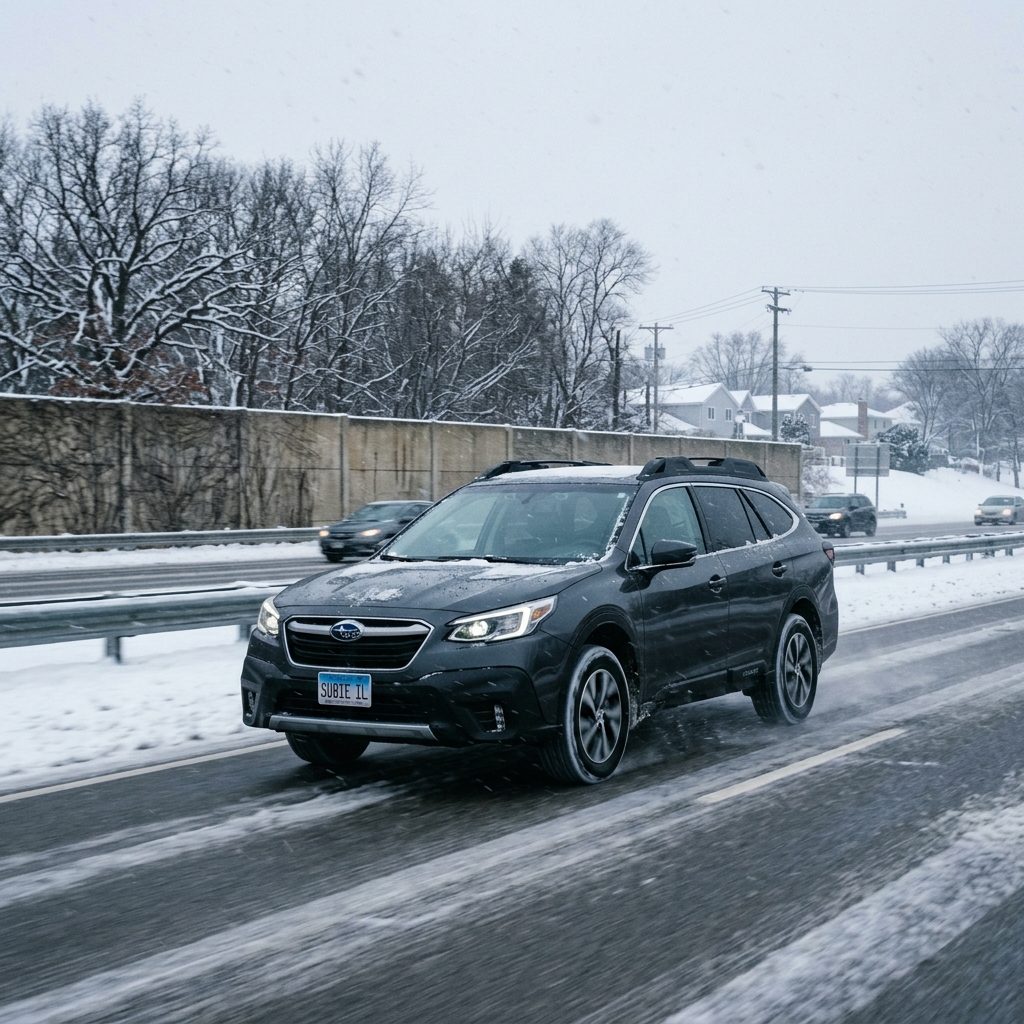
Drivers throughout Plainfield, Naperville, and Joliet understand the severe winter conditions that plague Will County every year. Sudden lake-effect snow squalls, freeze-thaw cycles creating invisible black ice along Interstate 55, and unplowed suburban corridors demand vehicle confidence. In these challenging regional conditions, continuous power distribution isn't merely a technical luxury—it is an active driver safety feature.
When traversing the Des Plaines River valley bridge decks or maneuvering along Route 59 during peak winter rush hours, sudden patches of slush can catch part-time FWD systems completely off guard. By maintaining active drive torque on all four wheels at all times, Subaru vehicles track straight through uneven snow ridges without dangerous torque steer or sudden traction loss. To test out these winter-proven capabilities firsthand, Get Directions to Hawk Subaru and speak with our knowledgeable team.
Fuel Efficiency vs. Traction Security: Debunking the Part-Time AWD Mileage Myth
The Traditional Fuel Economy Misconception
For decades, automotive sales rhetoric claimed that full-time all-wheel drive sacrificed fuel economy significantly compared to front-wheel-drive or part-time slip-and-grip systems. While this was historically true for heavy 4WD truck transfer cases with heavy parasitic drag, modern Subaru engineering has effectively eliminated this efficiency gap.
Lineartronic® CVT & Lightweight Drivetrain Optimization
By pairing the lightweight Subaru BOXER engine with the high-efficiency Lineartronic Continuously Variable Transmission (CVT), Subaru vehicles keep engine power precisely in its ideal efficiency band. Because drive torque flows seamlessly through a simplified inline transfer case without heavy secondary gearboxes, Subaru models achieve EPA fuel economy figures rivaling competitors' part-time FWD systems—giving you continuous 365-day security without high fuel costs.
Does Subaru Symmetrical AWD Cost Extra or Come Standard on Subaru Vehicles?
Standard Across Nearly All Trims
Unlike competitive brands that charge an additional $1,500 to $2,500 option fee for slip-and-grip AWD—or reserve traction features for expensive top-tier packages—Subaru includes Symmetrical AWD as standard equipment across nearly every vehicle model (Outback, Forester, Crosstrek, Ascent, Impreza, WRX, Legacy).
Transparent Upfront Value
When comparing total purchase cost against other SUVs, Subaru delivers exceptional value. Buyers receive a true continuous full-time AWD system included right in the base MSRP, rather than paying extra for reactive two-wheel drive baseline trims.
High Resale Value Retention
Because full-time Symmetrical AWD is highly sought after by secondary market buyers in cold-weather regions, Subaru models maintain industry-leading resale retention values over 3, 5, and 7 years of ownership.
Maintaining Your AWD System for Long-Term Reliability and Peak Performance
Matching Tire Tread Depth & Routine Rotation
Because Subaru Symmetrical AWD distributes torque continuously to all four positions, maintaining equal tire circumference across all wheels is critical. Mismatched tire tread depths exceeding 2/32nds of an inch force the center differential to slip continuously, generating unwanted fluid heat. Regular tire rotations every 6,000 miles ensure uniform wear patterns and protect drivetrain components.
Differential Fluid Servicing & Factory Maintenance
To maintain optimal mechanical heat dissipation, front and rear differential gear oil along with Lineartronic CVT fluid should be inspected at factory service intervals. Factory-trained technicians at the Hawk Subaru service department use genuine OEM lubricants formulated specifically for Subaru transfer gear systems. You can easily Schedule Your Service Today or visit our OEM Parts Center for technical maintenance support.
Trade-In and Upgrade: Finding the Right Symmetrical AWD Subaru Model for Your Family
Selecting the perfect full-time AWD vehicle depends on your lifestyle needs and family requirements. The versatile Subaru Crosstrek offers compact agility and 8.7 inches of ground clearance for daily city commutes. The iconic Forester provides expansive outward visibility and generous cargo volume, while the spacious Outback blends wagon comfort with rugged utility. Families needing 3-row seating can step up to the refined Ascent.
Upgrading your current vehicle to a full-time Symmetrical AWD model is straightforward at Hawk Subaru. You can evaluate your current car online to Value Your Trade-In or explore our extensive selection to Browse Used Inventory for exceptional pre-owned deals.
Experience Subaru Symmetrical All-Wheel Drive at Hawk Subaru in Plainfield
The best way to appreciate the unmatched stability, instant traction response, and engineering refinement of Subaru full-time Symmetrical All-Wheel Drive is from behind the wheel. Experience how seamless acceleration and balanced cornering feel on real Illinois roads.
Visit Hawk Subaru today at 2401 Route 59 in Plainfield, IL 60586. Have questions about inventory or want to arrange a test drive? Call us at (815) 725-3789 to speak directly with one of our friendly Subaru sales specialists.